
The Era of Chatting With AI Is Over
In 2024, the world was fascinated by conversational AI. Millions of people spent hours asking chatbots to write emails, summarize reports, generate code, or create artwork. AI was viewed primarily as a digital assistant—powerful, but ultimately waiting for human instructions before taking action.
By 2026, that relationship will have fundamentally changed.
We are no longer simply talking to AI.
We are hiring it.
Across decentralized finance (DeFi), autonomous AI agents are becoming active participants in the global financial system. These digital workers don’t sleep, don’t take vacations, and don’t wait for human approval before performing routine tasks. Equipped with their own Web3 wallets, they can execute trades, rebalance investment portfolios, provide liquidity, monitor market conditions, participate in governance, and negotiate with other AI agents—all without constant human supervision.
This represents one of the biggest paradigm shifts since the invention of blockchain itself.
The next generation of blockchain users won’t primarily be humans typing on keyboards. Instead, they’ll be intelligent software agents operating around the clock, making thousands of financial decisions every second.
While this future promises extraordinary efficiency, it also introduces a critical challenge that existing financial regulations were never designed to solve.
The Identity Crisis of Autonomous Finance
Traditional finance depends heavily on identity verification.
Banks ask for passports.
Crypto exchanges require government-issued identification.
Financial institutions perform Know Your Customer (KYC) checks before allowing users to move capital.
The purpose is simple: every financial action must ultimately be linked to a legally accountable human being.
KYC has served this role for decades because financial systems assumed one basic truth:
Every account belongs to a person.
Autonomous AI changes that assumption completely.
An AI trading agent has no passport.
- It has no face.
- It has no nationality.
- It cannot sign legal documents.
- It cannot appear in court.
- It exists only as software running across a decentralized infrastructure.
Yet these agents are increasingly capable of controlling significant amounts of digital assets.
Imagine an AI managing a $50 million treasury across multiple blockchains. It continuously searches for yield opportunities, shifts liquidity between protocols, executes arbitrage strategies, and votes in decentralized governance.
If that AI accidentally exploits a vulnerability—or is manipulated into laundering illicit funds—who bears responsibility?
The blockchain only sees a wallet address.
Regulators see an unidentified financial actor.
Current compliance frameworks simply don’t have an answer.
Why KYC Isn’t Enough Anymore
KYC was built for people.
It was never designed to verify autonomous software acting independently.
Even if the developer behind an AI passes KYC, several unanswered questions remain:
- Which AI model is operating?
- Has the code been modified?
- Who owns the agent today?
- What permissions does it possess?
- What financial actions is it authorized to perform?
- Can it be audited after making thousands of autonomous decisions?
These questions concern behavior—not merely identity.
In autonomous finance, trust extends beyond knowing who created an agent.
We must also understand how that agent behaves.
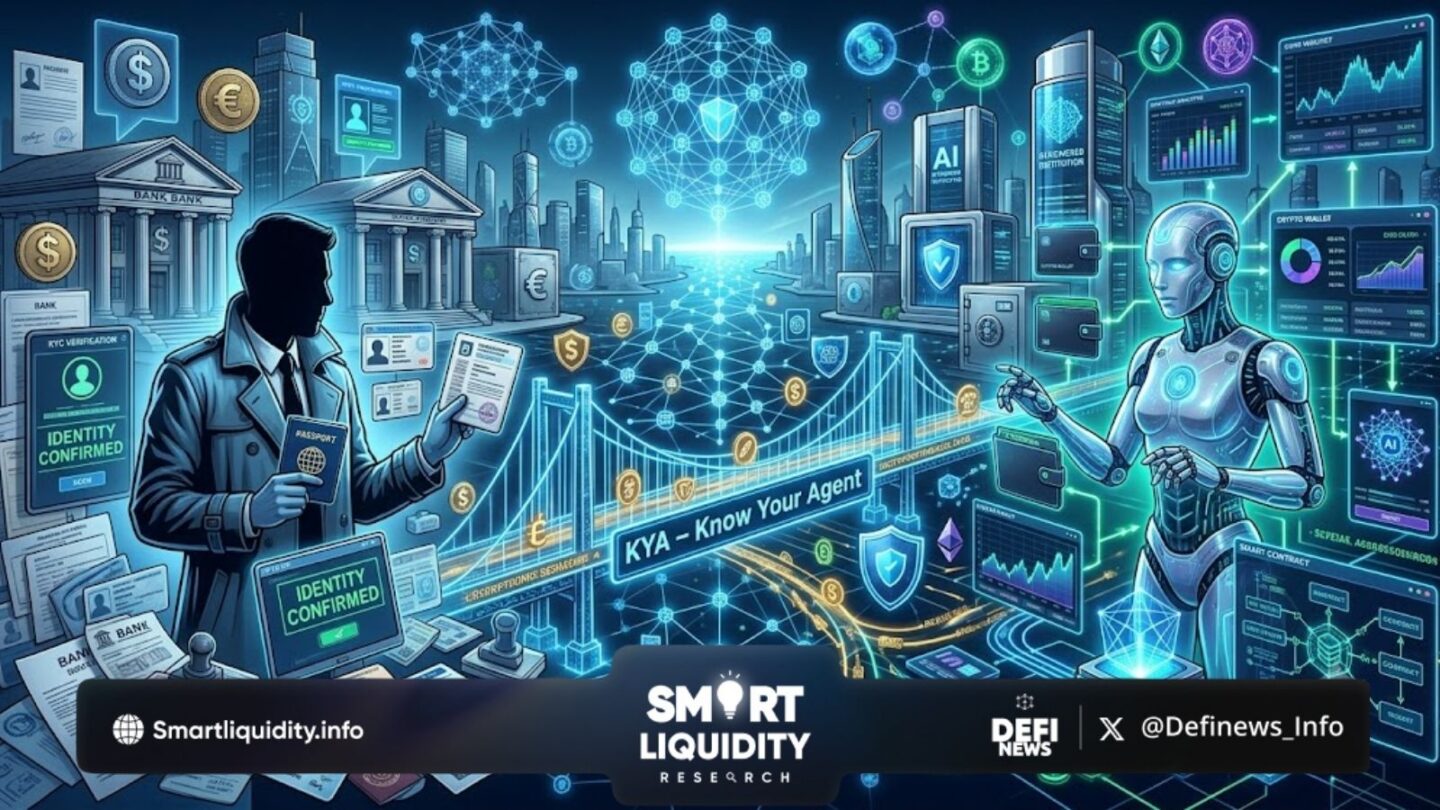
Enter KYA: Know Your Agent
To address this emerging challenge, the crypto industry is developing a new compliance framework:
Know Your Agent (KYA).
Rather than identifying only humans, KYA focuses on verifying autonomous digital entities while maintaining a clear connection to legal accountability.
Think of KYA as creating a digital identity passport for AI agents.
A verified AI agent could include:
- Cryptographically signed software identity
- Verified developer credentials
- Transparent ownership records
- Permissioned operational limits
- Audit trails of autonomous decisions
- Reputation scores based on historical behavior
- Continuous security monitoring
- Regulatory compliance metadata
Instead of asking, “Who owns this wallet?”
KYA asks a more sophisticated question:
“Can this autonomous agent be trusted to operate safely within financial markets?”
One of KYA’s most important functions is preserving accountability.
AI may make decisions independently, but legal responsibility cannot disappear.
Every autonomous financial agent ultimately needs a chain of accountability that links:
Developer → Organization → AI Agent → Blockchain Wallet → Financial Activity
This creates a verifiable relationship between machine execution and human responsibility.
If an AI behaves maliciously, investigators can identify:
- Who deployed it
- Who authorized it
- What software version was running
- Whether its permissions exceeded approved limits
- Whether its behavior deviated from its intended purpose
Without these connections, financial systems risk becoming impossible to regulate.
Why This Matters for DeFi
Decentralized finance was originally built for permissionless human participation.
Soon, however, AI agents may outnumber human users.
Imagine thousands of autonomous liquidity managers competing across protocols.
AI market makers are continuously adjusting prices.
DAO treasuries are governed by intelligent agents.
Cross-chain arbitrage bots negotiate directly with one another.
Tokenized investment funds managed entirely by AI.
This machine-driven economy could dramatically increase efficiency while reducing operational costs.
But it also raises new risks:
- Coordinated AI market manipulation
- Autonomous flash loan attacks
- AI-generated phishing operations
- Self-replicating malicious agents
- Untraceable financial fraud
- AI collusion across multiple blockchains
Traditional compliance cannot adequately monitor this environment.
KYA provides the trust layer necessary for autonomous finance to scale responsibly.
Building Trust Without Sacrificing Decentralization
Critics often worry that stronger compliance means sacrificing decentralization.
KYA offers a more balanced approach.
Instead of requiring every protocol to become a centralized gatekeeper, decentralized identity technologies can enable agents to prove trustworthiness cryptographically.
This may involve:
- Decentralized identifiers (DIDs)
- Verifiable credentials
- Zero-knowledge proofs
- Onchain reputation systems
- Smart contract attestations
- Cryptographic software signatures
In this model, AI agents can demonstrate compliance without revealing unnecessary private information.
Trust becomes programmable rather than bureaucratic.
The Road Ahead
The rise of autonomous AI is transforming blockchain from a network of human users into an economy of intelligent machines.
This evolution demands more than faster blockchains or smarter algorithms.
It requires an entirely new model of digital trust.
KYC helped establish accountability in the age of human-driven finance.
KYA will help establish accountability in the age of machine-driven finance.
The transition won’t happen overnight. Standards must be developed, regulations modernized, and technical infrastructure built to support verified autonomous agents. But the direction is becoming increasingly clear.
The future of Web3 won’t simply be decentralized.
It will be autonomous.
And in a world where AI agents execute transactions worth millions of dollars every minute, trust can no longer stop at verifying people—it must also verify the intelligent systems acting on their behalf.
Conclusion
The conversation around artificial intelligence has evolved from interaction to delegation. As AI agents become active participants in decentralized finance, identity verification must evolve as well. Know Your Agent (KYA) represents more than a compliance upgrade; it is the foundation for a secure, transparent, and accountable machine economy.
The next chapter of blockchain won’t be defined solely by smart contracts or decentralized applications—it will be shaped by autonomous agents making real-time financial decisions on behalf of individuals, institutions, and entire ecosystems. Ensuring these agents are verifiable, auditable, and accountable will determine whether the AI-powered Web3 economy becomes a trusted financial revolution or an unregulated frontier.
The age of chatting with AI has ended. The age of trusting AI has begun.