
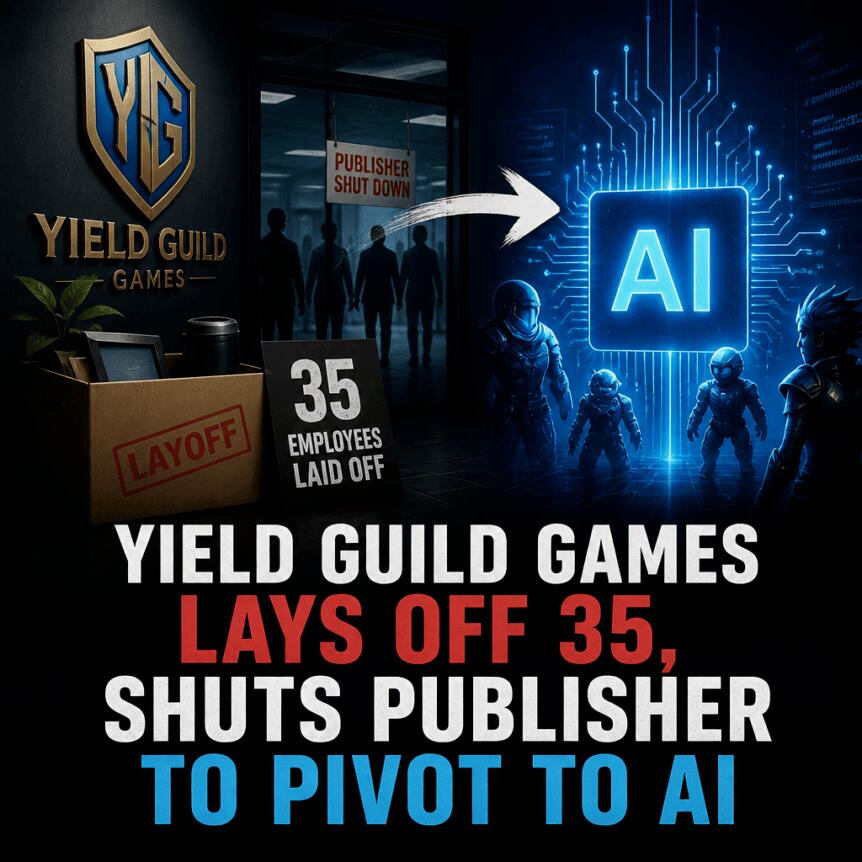
Yield Guild Games (YGG) has moved to shut down its crypto game publishing arm, YGG Play, while cutting 35 employees and redirecting resources toward AI-focused datasets. The restructuring comes as the company cites a prolonged downturn in crypto markets alongside a difficult environment for video game publishing.
In an update posted Monday, YGG said it is sunsetting the web-based publishing activities under YGG Play because it no longer expects consumer demand in crypto gaming or the broader Web3 publishing market to recover “sufficiently” in the near term. The company also attributed the shift to how a major market crash on Oct. 10 “fundamentally altered retail market psychology.”
Key takeaways
- Yield Guild Games is sunsetting YGG Play, ending its publishing website, web app experience, and community rewards support.
- The company will lay off 35 employees, pointing to weak crypto consumer conditions and an unsustainable publishing market.
- YGG says the restructure extends its operating runway to four years, citing $20.6 million in treasury funds as of the end of the first quarter.
- Instead of publishing games, YGG plans to build “AI data economy” pipelines using behavioral datasets generated by its global community through gameplay.
Sunsetting YGG Play amid market stress
According to YGG’s announcement, the decision is driven less by product performance and more by the economics of Web3 game publishing under current conditions. The company said YGG Play “cannot be commercially sustainable,” blaming both a continued crypto market slump and what it called a “similarly brutal” video game publishing landscape.
In a brief statement included with the update, YGG co-founder Gabby Dizon framed the move as a response to market realities. She said sunsetting YGG Play is a “market decision, not a product decision,” adding that she was “proud of what this team achieved under such tough conditions.”
As part of the shutdown, YGG said it will close the YGG Play website, discontinue its web app used to launch games, and end marketing support for third-party titles. That includes taking down specific games listed as browser-based offerings, while other Web3 versions are set to remain accessible.
What ends—and what stays live
YGG said it will remove LOL Land, a browser game described as a “game in the style of a board game,” and also take down the puzzle game Waifu Sweeper.
However, YGG indicated that Web3 versions of two other titles would continue as normal. Those are the baseball game GIGACHADBAT and the battle game Ragnarok Breaker. The company’s update suggests that it will focus on maintaining certain blockchain-based game experiences while stopping the publishing and support layer that sits behind YGG Play’s broader web infrastructure.
The company also said it would end marketing support for third-party games distributed through YGG Play, signaling that the restructure is not limited to internal game development but also affects the broader publishing and promotion function.
From publishing to AI training data pipelines
While sunsetting YGG Play, Yield Guild Games says it is pivoting toward “the AI data economy.” The company’s plan is to use its community to create datasets designed to help train AI systems.
YGG stated it will initially build a pipeline for gaming datasets and that its global community “can generate these behavioral datasets just by playing.” In other words, rather than monetizing publishing as a standalone activity, YGG is positioning gameplay behavior as a raw input for AI model training.
The company also argued that games create complex, real-time decision-making environments. In YGG’s framing, video game players continually make split-second choices, often involving “human irrationality and emergent behavior,” which it says AI networks could benefit from learning.
This shift reframes YGG’s role in the Web3 ecosystem: from distributing and promoting games to contributing structured behavioral information that can support AI development.
Runway extended, layoffs align with broader crypto job cuts
YGG said the sunsetting of YGG Play and the associated restructuring will extend its operating runway to four years. The company added that it held $20.6 million in treasury as of the end of the first quarter.
The layoffs at YGG are part of a wider wave of workforce reductions across the crypto sector. Data cited in the reporting shows that crypto companies have cut more than 5,000 jobs this year, with many employers citing difficult market conditions and a redirection of budgets toward artificial intelligence initiatives.
Examples highlighted include Block Inc.’s large February layoff round in which it cut 4,000 staff, roughly half its workforce at the time, according to earlier coverage from Cointelegraph. BitGo later laid off about 15% of staff (estimated at 90 people), while Robinhood reportedly reduced its workforce by 10%. Earlier in the year, Kraken said it cut 150 roles and Coinbase reduced 700 employees, with Gemini also cutting 200 employees in February and Crypto.com reducing about 180 staff the following month—again citing the role of AI in shaping staffing priorities.
For investors and builders, the pattern suggests companies are not only tightening costs, but also changing what they view as the most durable growth lever. In YGG’s case, that lever is shifting from Web3 entertainment publishing toward data production tied to AI training—an approach that may be less dependent on immediate consumer spending on new crypto game launches.
What remains to be seen is how YGG will translate community gameplay into usable datasets in practice, and whether its AI data direction can generate sustainable revenue or partnerships at scale. Readers should watch for details on the pipeline, how YGG measures dataset quality and value, and which of its current game experiences remain central to that data strategy as the YGG Play transition continues.