
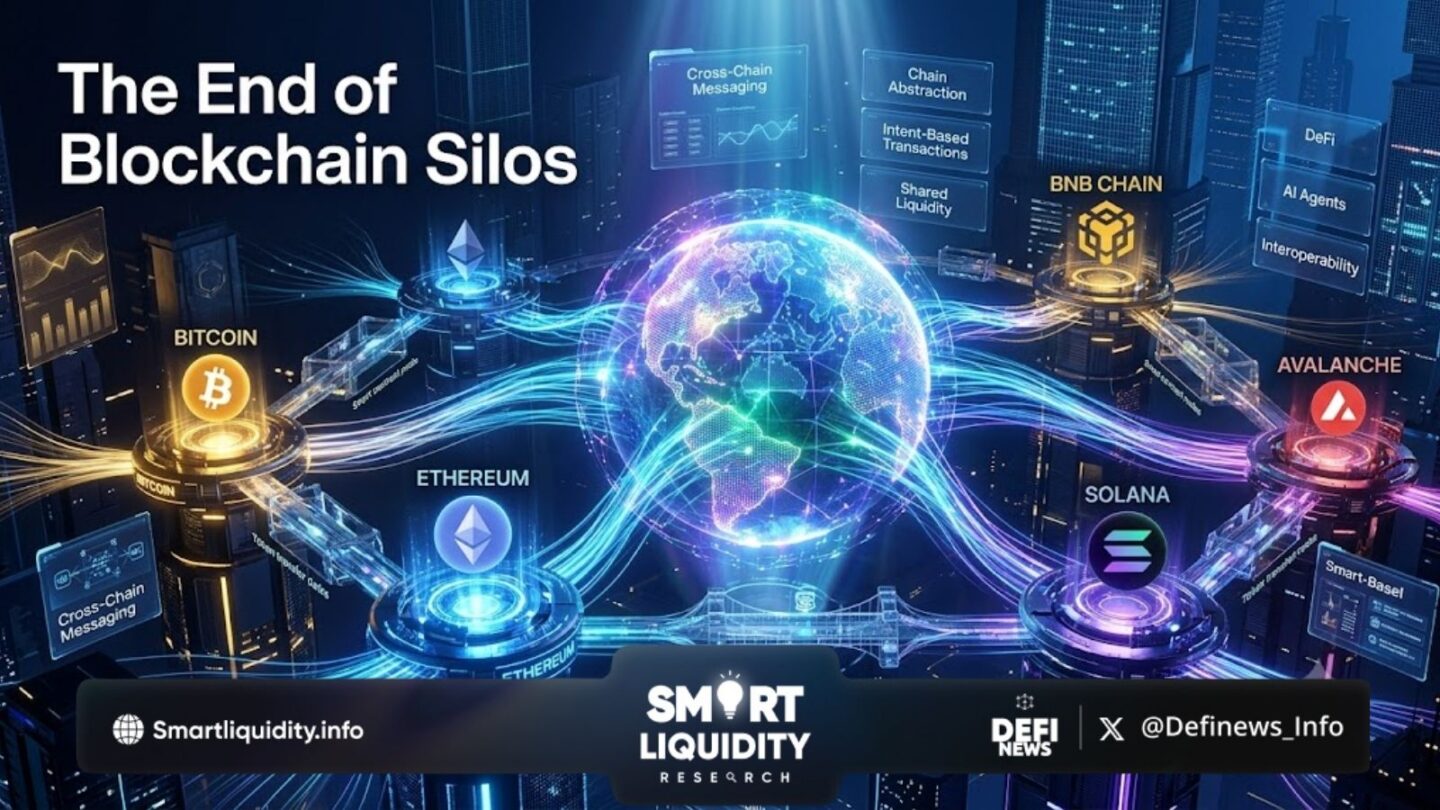
Blockchain technology has evolved rapidly over the past decade, giving rise to hundreds of networks optimized for different use cases. Some prioritize speed, others focus on security, privacy, scalability, or specialized applications like gaming and decentralized finance (DeFi). While this diversity has fueled innovation, it has also created one of Web3’s biggest challenges: blockchain silos.
Today, the industry is moving toward a future where blockchains no longer operate as isolated ecosystems. Instead, they’re becoming interconnected networks that can communicate, exchange assets, and share data seamlessly. This shift could redefine how decentralized applications (dApps), users, and institutions interact with blockchain technology.
What Are Blockchain Silos?
A blockchain silo exists when a network operates independently without native communication with other blockchains. Assets, data, and smart contracts remain confined to their respective ecosystems.
For example:
- Bitcoin primarily serves as a secure store of value.
- Ethereum powers a vast ecosystem of smart contracts.
- Solana focuses on high-speed transactions.
- BNB Chain emphasizes affordable and scalable DeFi.
- Avalanche offers customizable blockchain infrastructure.
Each blockchain has unique strengths, but moving assets or information between them has traditionally required third-party bridges or centralized exchanges.
This fragmentation often creates unnecessary complexity for users and developers alike.
The Problems Caused by Blockchain Silos
1. Fragmented Liquidity
Liquidity scattered across multiple blockchains reduces capital efficiency. Instead of one unified financial ecosystem, liquidity is divided among separate networks, making markets less efficient.
2. Poor User Experience
Managing several wallets, switching networks, paying different gas fees, and learning multiple interfaces discourages mainstream adoption.
3. Limited Application Potential
Developers often build applications for a single blockchain, restricting access to users and liquidity from other ecosystems.
4. Security Risks
Traditional cross-chain bridges have become attractive targets for hackers. Billions of dollars have been lost through bridge exploits over the past several years, highlighting the need for more secure interoperability solutions.
The Rise of Blockchain Interoperability
Instead of competing in isolation, blockchain ecosystems are increasingly embracing interoperability—the ability for different blockchains to communicate securely.
Modern interoperability solutions aim to allow:
- Cross-chain asset transfers
- Cross-chain messaging
- Shared liquidity
- Multi-chain smart contract execution
- Unified user experiences
Rather than forcing users to choose one blockchain, interoperability allows them to benefit from many simultaneously.
Technologies Driving the End of Silos
Cross-Chain Messaging
Instead of merely transferring tokens, cross-chain messaging enables smart contracts on one blockchain to trigger actions on another.
This opens the door to far more sophisticated decentralized applications.
Interoperability Protocols
Dedicated interoperability layers provide standardized communication between independent blockchains.
These protocols reduce fragmentation while allowing each network to maintain its own security and governance.
Chain Abstraction
One of the biggest emerging trends is chain abstraction.
Instead of asking users to manually manage networks, wallets, bridges, and gas tokens, applications handle the complexity behind the scenes.
Users simply interact with the application while the infrastructure determines the optimal blockchain for each transaction.
Intent-Based Architecture
Intent-based systems allow users to specify their desired outcome rather than manually executing every blockchain interaction.
For example:
Instead of bridging tokens, swapping assets, and staking manually, a user simply requests:
“Stake my stablecoins in the highest-yield lending protocol.”
The protocol automatically completes every required cross-chain action.
Benefits of an Interoperable Future
Better Capital Efficiency
Assets can move freely across ecosystems, creating deeper liquidity and more efficient markets.
Improved User Experience
Users no longer need to understand every blockchain’s technical details. Applications become as simple as traditional fintech apps.
More Powerful Applications
Developers gain access to users, assets, and services across multiple chains, enabling richer decentralized applications.
Greater Ecosystem Collaboration
Instead of competing for users, blockchain networks can specialize while remaining connected through shared infrastructure.
Challenges That Still Need Solving
Although interoperability has advanced significantly, several challenges remain.
Security
Cross-chain infrastructure must maintain strong security guarantees without introducing centralized trust assumptions.
Standardization
The industry still lacks universal standards for messaging, identity, and asset transfers across every blockchain.
Scalability
As interoperability grows, systems must efficiently process increasing volumes of cross-chain communication.
Governance
Coordinating upgrades across multiple decentralized ecosystems remains a complex challenge.
What This Means for DeFi
The end of blockchain silos could dramatically reshape decentralized finance.
Future DeFi platforms may automatically source liquidity from multiple chains, optimize yields across ecosystems, and execute transactions wherever conditions are most favorable—all without requiring users to manually bridge assets or switch networks.
This could make decentralized finance significantly more accessible to everyday users while improving efficiency for institutional participants.
Beyond DeFi: A Unified Web3
Interoperability extends far beyond finance.
Potential applications include:
- Cross-chain gaming assets
- Portable digital identities
- Interoperable NFTs
- Multi-chain DAOs
- Unified social networks
- Enterprise blockchain integration
- AI agents coordinating across decentralized ecosystems
Rather than existing as separate blockchain islands, these services could operate within one connected Web3 ecosystem.
Conclusion
The next phase of blockchain evolution isn’t about finding a single “winning” blockchain—it’s about enabling all blockchains to work together.
As interoperability protocols, chain abstraction, and intent-based systems mature, users may no longer need to think about which blockchain they’re using. Just as internet users rarely consider which servers deliver a website, future Web3 users may simply interact with applications while the underlying infrastructure seamlessly coordinates across multiple networks.
The end of blockchain silos represents more than a technical milestone. It marks the transition from isolated blockchain ecosystems to a truly interconnected decentralized internet—one where assets, applications, and information flow freely across networks, unlocking the full potential of Web3.