
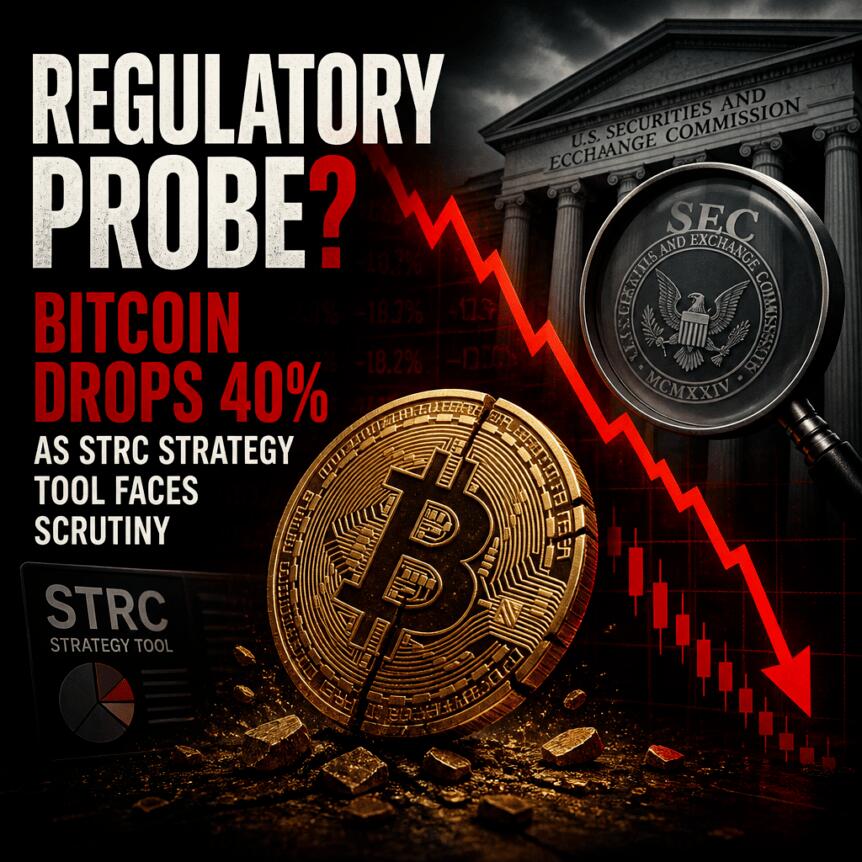
MicroStrategy’s flagship Bitcoin funding vehicle, Strategy’s Stretch (STRC)has traded at a persistent discount to its $100 liquidation preference since late July 2025, prompting renewed scrutiny of its capital-raising design. As STRC’s market price fell to new lows in the lead-up to mid-2026, critics framed the move as evidence that the structure may rely on continuous inflows to meet shareholder expectations.
At the same time, other analysts argue the steep drawdown reflects leverage dynamics rather than a fundamental deterioration in Strategy’s Bitcoin accumulation plan. For institutional stakeholders, the episode matters not only for how STRC functions economically, but also for how such instruments fit within broader oversight and investor-protection frameworks—particularly as leveraged exposures and yield-linked terms raise compliance and risk-management questions.
Key takeaways
- STRC was structured to trade near its $100 par (liquidation preference) via adjustable dividends tied to that benchmark.
- In mid-2026, STRC traded materially below $100, with reports indicating a late-day close below par after a record low intraday print.
- The widening discount has coincided with a slowdown in Strategy’s weekly Bitcoin additions, increasing attention on funding efficiency.
- Critics—including Peter Schiff—reiterated claims that the instrument resembles a “centralized Ponzi,” while analysts counter that leverage wipeouts better explain the move.
- STRC’s dividend mechanics are being debated in terms of how the liquidation preference converts into an effective yield for discounted entry prices.
Why STRC’s discount to $100 is drawing regulatory-style scrutiny
STRC was introduced in July 2025 as a preferred-equity style instrument designed to remain close to its $100 par value, supported by adjustable dividends. The practical objective, as described by market participants around the offering, is to create a predictable redemption/return framework while enabling Strategy to raise capital to purchase additional Bitcoin.
According to the reported trading updates, STRC fell to an intraday record low of $82.53 and closed around $88.59—still below the $100 liquidation preference. While a discount can occur for many reasons in credit-like and preferred structures, sustained divergence from par tends to intensify investor-protection concerns: it can indicate that the market assigns a higher probability of stress scenarios than the instrument’s contractual yield implies.
That dynamic is now fueling accusations that STRC depends on ongoing capital formation to sustain returns—an argument Peter Schiff has repeated, describing STRC as “a classic centralized Ponzi.” Critics’ central compliance-adjacent concern is not the existence of leverage per se, but the possibility that the structure’s economics may become self-reinforcing in a way that disadvantages later entrants if market prices cannot stabilize near par.
Strategy has not, in recent public statements cited in the reporting, directly engaged with the “Ponzi” characterization. Instead, it continues to position STRC as preferred equity supported by its Bitcoin treasury strategy. Nevertheless, the market’s focus has shifted to the contract terms that link dividends to the $100 benchmark and to the implications for investors who adopt leveraged positions.
From an institutional monitoring perspective, this is the kind of dispute that can evolve into formal regulatory or litigation scrutiny: when the price relationship to a stated benchmark deteriorates, supervisors and compliance teams typically ask whether disclosure and risk labeling adequately reflect the instrument’s downside behavior, including margin-call pathways for leveraged holders.
Dividend mechanics and the effective yield debate
Reportedly, STRC uses an adjustable dividend framework with a currently stated 11.5% annualized rate, with proceeds primarily directed toward acquiring Bitcoin. However, the instrument’s market price movement changes how discounted investors interpret return.
Analysts cited in the coverage argue that STRC dividends are calculated relative to the $100 liquidation preference rather than the current market price. Under that interpretation, a discounted entry can produce a higher effective yield than the headline rate. For example, one analyst noted that at $90the effective yield would be approximately 12.8%while at $85 it could be around 13.5%assuming the dividend rate remains anchored to the $100 liquidation preference.
This distinction matters in practice because it highlights a structural tension: a vehicle can offer an attractive contractual yield while still trading far below par due to market-implied stress, forced deleveraging, or holder expectations about future dividend adjustments and redemption outcomes.
Strategy’s next dividend rate announcement has been reported as scheduled for June 30with the company reportedly retaining alternative funding options such as issuing additional Strategy shares and using cash reserves—elements that, from a governance standpoint, influence whether the instrument is likely to remain within a stable pricing band or whether it will continue to trade at a deep discount.
Slower Bitcoin purchases and funding-efficiency questions
Alongside the price drawdown, reporting indicates that Strategy’s pace of Bitcoin accumulation moderated as STRC traded below par. The company added 1,550 BTC for $101 million in the week ending June 8 and 1,587 BTC for $100 million in the week ending June 15taking total holdings to 846,842 BTC.
These additions were meaningful, but the weekly dollar amounts were reported to be much smaller than earlier in 2026. For comparison, Strategy was reported to have bought 34,164 BTC for $2.54 billion in a single week during April, and 24,869 BTC for roughly $2.01 billion in May—figures that underscore how the “cash-in-to-BTC” conversion can change when the funding vehicle trades at a discount.
In addition, a small Bitcoin sale was reported earlier in June—32 BTCworth approximately $2.5 million—described as potentially linked to dividend obligations. While the sale was minimal relative to the size of Strategy’s overall treasury, it reflects a key operational reality for dividend-linked structures: even if the primary plan is to finance purchases via issuance proceeds, cash requirements can still require asset sales when market conditions weaken.
In institutional terms, this is where compliance and risk governance intersect with capital markets execution. A vehicle that depends on continuous issuance can face liquidity and market-impact constraints when its own price dislocates from its stated preference benchmark, potentially affecting obligations to income-seeking or leveraged investors.
Leverage wipeout vs. structural failure
Not all analysts interpret STRC’s decline as a sign of failing fundamentals. Jesse Myers, head of Bitcoin strategy at The Smarter Web Company, argued that the move resembles a leverage wipeout rather than an impairment in Strategy’s broader positioning. In the cited commentary, Myers suggested that STRC holders might assume stable trading near the $99–$100 band and that once the price fell, margin calls and forced selling amplified the downward momentum.
Other market commentators similarly focus on how leveraged investors can create nonlinear liquidation dynamics: a discount that begins as a repricing can become accelerated when position sizing is calibrated to assumptions that do not hold.
Still, the debate remains unresolved for compliance observers because both narratives—leverage-driven volatility and structural dependence—can coexist. The instrument may behave as expected under certain conditions while also exhibiting fragile performance when market participants reduce exposure or when funding terms become less favorable. That uncertainty is precisely what supervisors and institutional risk teams often seek to clarify through documented scenario analysis, stress testing, and disclosures around redemption, dividend adjustment triggers, and investor suitability.
Closing perspective
With STRC continuing to trade below its $100 liquidation preference and with dividend-rate decisions and capital-raising activity tied to that benchmark, the next dividend announcement and any further changes in issuance patterns will likely determine whether the discount stabilizes or deepens. For institutional compliance and legal teams, the episode highlights the importance of monitoring how leveraged investor behavior and contract-linked yield mechanics interact with pricing—especially for instruments positioned as central to a broader Bitcoin treasury strategy.