
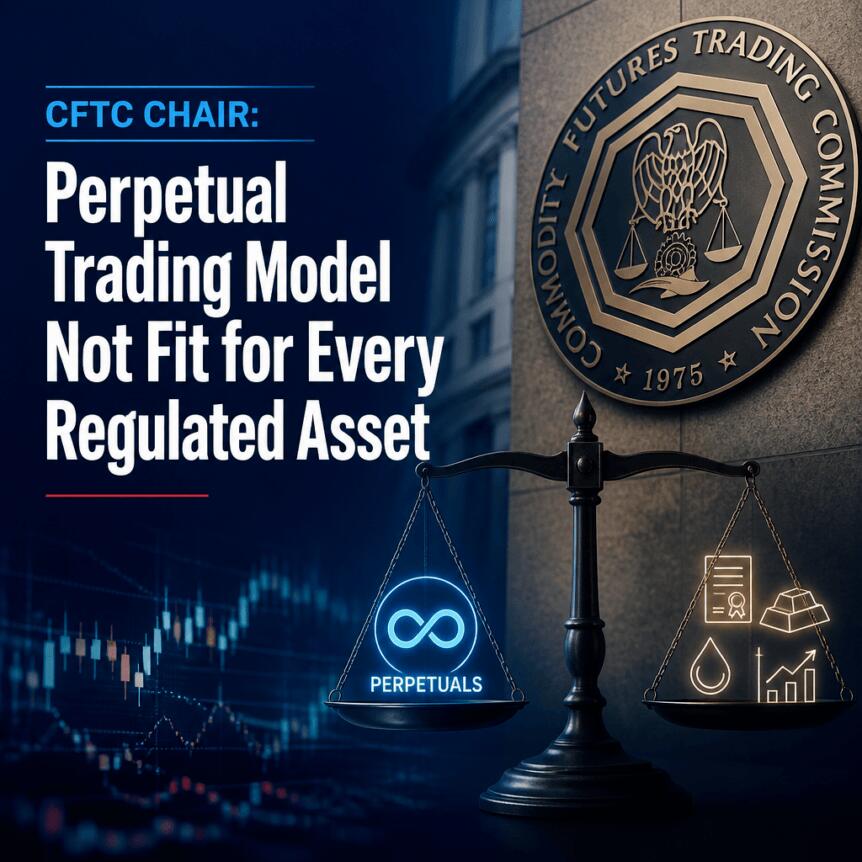
Commodity Futures Trading Commission (CFTC) Chair Michael Selig used remarks delivered this week to emphasize that the agency’s traditional commodity framework does not always map cleanly onto the mechanics of crypto markets—particularly perpetual products that run continuously and depend on price references rather than physical delivery.
Speaking at the American Cotton Shippers Association Annual Convention on Tuesday, Selig said the CFTC’s long-standing mandate across agricultural and other physical commodities cannot be treated as a one-to-one fit for digital-asset perpetual contracts, which operate on a 24/7 basis. His comments arrive amid ongoing scrutiny of the CFTC’s growing role in approving and regulating certain crypto derivatives.
Key takeaways
- Selig argued that perpetual, 24/7 trading and the lack of physical delivery make crypto perpetual contracts a “not natural fit” for traditional commodity markets like agriculture.
- The chair’s remarks followed CFTC decisions that included approving Bitcoin spot-referenced perpetual futures for Kalshi and issuing a no-action position for similar products on Coinbase.
- Legal challenges continue as critics argue the CFTC approvals overstep authority under the Commodity Exchange Act, including a CME lawsuit filed in the District of Columbia.
- The CFTC remains under a single Republican commissioner and has not seen nominations to complete its five-person leadership panel since Caroline Pham’s departure in December 2025.
- Congress is expected to consider the CLARITY Act soon, which could reshape how the CFTC and SEC divide oversight of digital assets.
Why Selig says perpetual contracts don’t match traditional commodity realities
Selig framed the CFTC’s perspective around fundamental differences between legacy commodities and crypto-based derivatives. Cotton and other agricultural goods are typically tied to market structures that observe limited trading hours and, in many cases, incorporate physical delivery expectations.
Addressing the mismatch directly, he said the industry’s move toward perpetual models is structurally different from agriculture-based trading. “We fully recognize and understand that 24-7 trading and the perpetual model is not a natural fit for traditional commodity markets, like agriculture, that observe limited trading hours and rely on physical delivery,” Selig said, according to his remarks to the American Cotton Shippers Association.
While the CFTC regulates futures and derivatives tied to commodities, his comments suggest an internal awareness that regulators may face conceptual tension when applying long-established rules to products designed for always-on digital markets. For market participants, that matters because regulatory outcomes often hinge on whether a product can be characterized as sufficiently similar to the commodity derivatives the agency has long overseen.
CFTC approvals and no-action positions set the stage
Selig’s remarks came after the CFTC took steps that brought crypto perpetual products deeper into its orbit. Earlier coverage from Cointelegraph noted that the agency approved perpetual futures contracts linked to the spot price of Bitcoin for Kalshi’s prediction markets platform, and it issued a no-action position for similar products on Coinbase in May.
Subsequently, Kraken expanded access for US users by launching perpetual futures trading through its CFTC-regulated platform, Bitnomial. Those actions reflect a willingness by the CFTC—at least under current interpretations—to treat certain crypto perpetual arrangements as derivable from commodity futures frameworks, even though the products are designed for continuous trading and do not rely on physical delivery.
The contrast between Selig’s “not a natural fit” framing and the CFTC’s approval activity is likely to remain a focal point for firms trying to forecast how far the agency’s authority extends. If regulators view the product category as inherently different, the question becomes what legal hook supports oversight and how consistently the agency will apply it across new platforms and contract structures.
Backlash over the CFTC’s “exclusive jurisdiction” stance
Selig’s broader position—at times described as the CFTC holding “exclusive jurisdiction” over certain areas of prediction markets and approving crypto perpetual futures—has not gone uncontested. The controversy intensified as legal and political actors challenged whether the CFTC’s actions align with the Commodity Exchange Act.
According to earlier reporting from Cointelegraphthe Chicago Mercantile Exchange (CME) Group filed suit against the CFTC in the District of Columbia last week. CME’s complaint alleges that the perpetual contract approvals violated the Commodity Exchange Act, according to the description of the filing in that coverage.
The existence of simultaneous regulatory activity and litigation underscores a key uncertainty for builders and traders: even if a product receives approval or regulatory comfort through no-action determinations, those permissions may still be vulnerable to legal reinterpretation. In practice, this can affect product roadmaps, risk management choices, and the willingness of venues to launch new derivative offerings.
CFTC leadership gaps add another layer of uncertainty
Separate from the courtroom fight, the CFTC’s decision-making environment is also being shaped by staffing. Despite lawmakers urging action, President Donald Trump has not moved to fill out the agency’s leadership panel. At present, Selig remains the only commissioner and chair on the CFTC.
Cointelegraph previously noted that Selig has been the sole Republican commissioner and chair following the departure of Caroline Pham in December 2025. The CFTC’s five-person structure matters because additional commissioners can influence how the agency interprets its mandate, how it balances competing legal theories, and whether it changes course on crypto-related derivative oversight.
Looking ahead, the US Senate is expected to take up a vote on the Digital Asset Market Clarity (CLARITY) Act in the coming weeks. If the legislation advances, it could alter how oversight responsibilities are divided between the CFTC and the Securities and Exchange Commission, potentially changing the regulatory landscape for digital asset derivatives and other crypto market products.
What traders and platforms should watch next
With Selig highlighting structural mismatches between perpetual crypto trading and traditional commodity markets, alongside active litigation and pending congressional action, the next signals will likely come from court developments and the pace of the CLARITY Act process. Market participants should monitor whether the CFTC’s legal posture is strengthened or narrowed in response to the lawsuits—and whether a broader statutory framework ends up clarifying what the agency can authorize under existing commodity derivatives laws.