

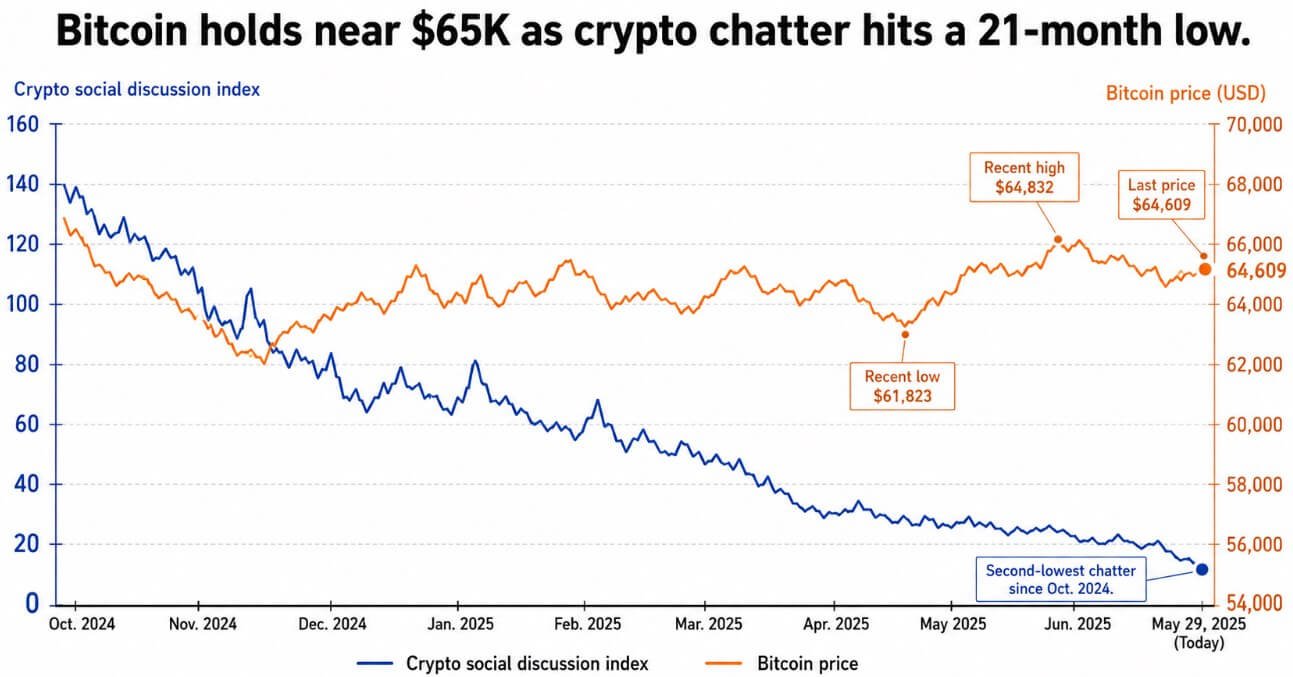
Crypto discussion across X, Reddit, Telegram, and other major social channels has fallen to its second-lowest daily level since October 2024, according to Santiment.
Bitcoin holds near $64,609 through that same stretch, with an intraday high of $64,832 and a low of $61,823 in recent sessions.
That combination usually reads as a setup in which retail traders stop chasing every price move, making positioning less crowded and allowing larger investors to accumulate before public attention returns, at least in theory.
A whale cohort divided
CryptoQuant found that wallets holding 100 to 1,000 BTC distributed roughly 67,000 BTC on July 13, the cohort’s strongest selling activity since February.
At current prices, that comes to about $4.3 billion moving out of those wallets in a single day, equal to roughly 0.33% of Bitcoin’s circulating supply of nearly 20 million BTC.
A separate CryptoQuant analysis points out that newer whale wallets have continued accumulatingwith supply rotating away from older whale cohorts toward these newer ones.
That split describes a redistribution of Bitcoin’s supply between large-holder cohorts, two groups making different bets on the same asset at the same moment.
| Cohort / signal | Recent behavior | Scale | Market read |
|---|---|---|---|
| 100–1,000 BTC wallets | Distributed BTC on July 13 | ~67,000 BTC / ~$4.3B | Major holder cohort used the rebound to reduce exposure |
| Newer whale wallets | Continued accumulating | Not specified in article | Suggests supply is rotating to newer large holders |
| Circulating supply comparison | 67,000 BTC versus nearly 20M BTC supply | ~0.33% of supply | Large enough to matter as a flow signal, not enough alone to define the market |
| Core implication | Whale behavior is divided | N/A | Bitcoin is undergoing redistribution, not uniform accumulation |
Why the silence only helps if demand shows up
Saintly frames extremely low levels of discussion as a form of market quiet that can precede turning points, the logic being that a less crowded trade leaves more room for a modest move in demand to push price further.
The firm pairs this with its caution about macro uncertaintyETF flow swings, and a still-cautious risk appetite that is working against Bitcoin.
Low attention becomes a genuine marker only if the wallets buying during the quiet stretch are absorbing the supply the crowd left behind, the question the CryptoQuant split leaves open.
Farside Investors’ data shows US-traded spot Bitcoin ETFs pulled in about $197.4 million over the July 6-10 weeka positive stretch that reversed hard on July 13, with roughly $424.7 million in net outflows that day.
Glassnode’s tracking puts 30-day ETF net flows in negative territorywith daily trading volume running $650 million to $950 million, about 80% below the October 2025 peak.
Measured against the $4.3 billion the 100-to-1,000 BTC cohort moved in a single day, that week’s entire ETF inflow was roughly 22 times smaller.
Institutional demand has shown signs of life, at a scale still well short of what’s needed to absorb the volume that large holders are distributing.
The levels that confirm a bottom
Bitcoin has spent about five months below both the short-term holder cost basis near $72,200 and the True Market Mean near $76,600, the two levels Glassnode uses to define a completed recovery.
Long-term holder realized losses peaked near $280 million a day, the highest since December 2022, evidence of how far capitulation has already run, with the pace still too hot to call the process finished.
The Fed held its target range at 3.50% to 3.75% at its June 17 meetingand June CPI cooled to 3.5% year over year from 4.2% in May, easing some of the strain that had weighed on risk assets.
Glassnode’s report also flags oil shocks and risk-off behavior as live threats, noting Bitcoin has recently traded in close step with broader risk assets, behaving as one more risk asset among many.
US M2 supply has risen to a record $22.8 trillion. In comparison, the Fed’s balance sheet sits roughly $2 trillion below its 2023 peak, leaving Bitcoin caught between expanding broad liquidity and a still-restrictive real-yield environment.
What determines the next leg
If new-whale accumulation persists, distribution from the 100-to-1,000 BTC cohort cools, and ETF flows turn positive for several consecutive weeks, Bitcoin has a path toward reclaiming both the $72,200 cost basis and the $76,600 True Market Mean.
That is a territory which Citi’s July forecast treats as an $82,000 base case with real room to run beyond it.
| Path | What needs to happen | Key BTC levels | Forecast context | Interpretation |
|---|---|---|---|---|
| Bullish repair | New-whale accumulation persists, 100–1,000 BTC distribution cools, ETF flows turn positive for several weeks. | Reclaim $72,200, then $76,600 | Citi base case: $82,000 | The silence was accumulation before attention returned |
| Incomplete rebound | BTC holds low-$60Ks, but ETF flows remain choppy, and whale cohorts stay divided | Fails below $72,200 | Range-bound recovery | Market is bottom-building but not confirmed |
| Bearish failure | Distribution continues; ETF flows revert to negative; LTH capitulation remains elevated. | Lose low-$60Ks | Citi bear case: $53,000 | Low chatter was not contrarian; it reflected weak demand |
If that distribution continues, ETF flows revert to negative again, and long-term holder capitulation stays elevated, Bitcoin risks losing the low-$60,000s entirely.
Citi’s July revision, which cut its 12-month target to $82,000 from $112,000, citing weak investor appetite and stalled US crypto legislation, puts its bear case at $53,000 under those recessionary conditions.
What happens next comes down to whether the wallets accumulating during the silence can absorb the supply still leaving the hands of holders choosing to exit before that bottom gets confirmed.