
Key Takeaways
- Tangem CEO Marcos Nunes argues users will move away from banks holding their money toward self-custody.
- Rather than disappearing, traditional banks are becoming less central as blockchain usage grows, he said.
- Despite strong growth, crypto still faces complex challenges.
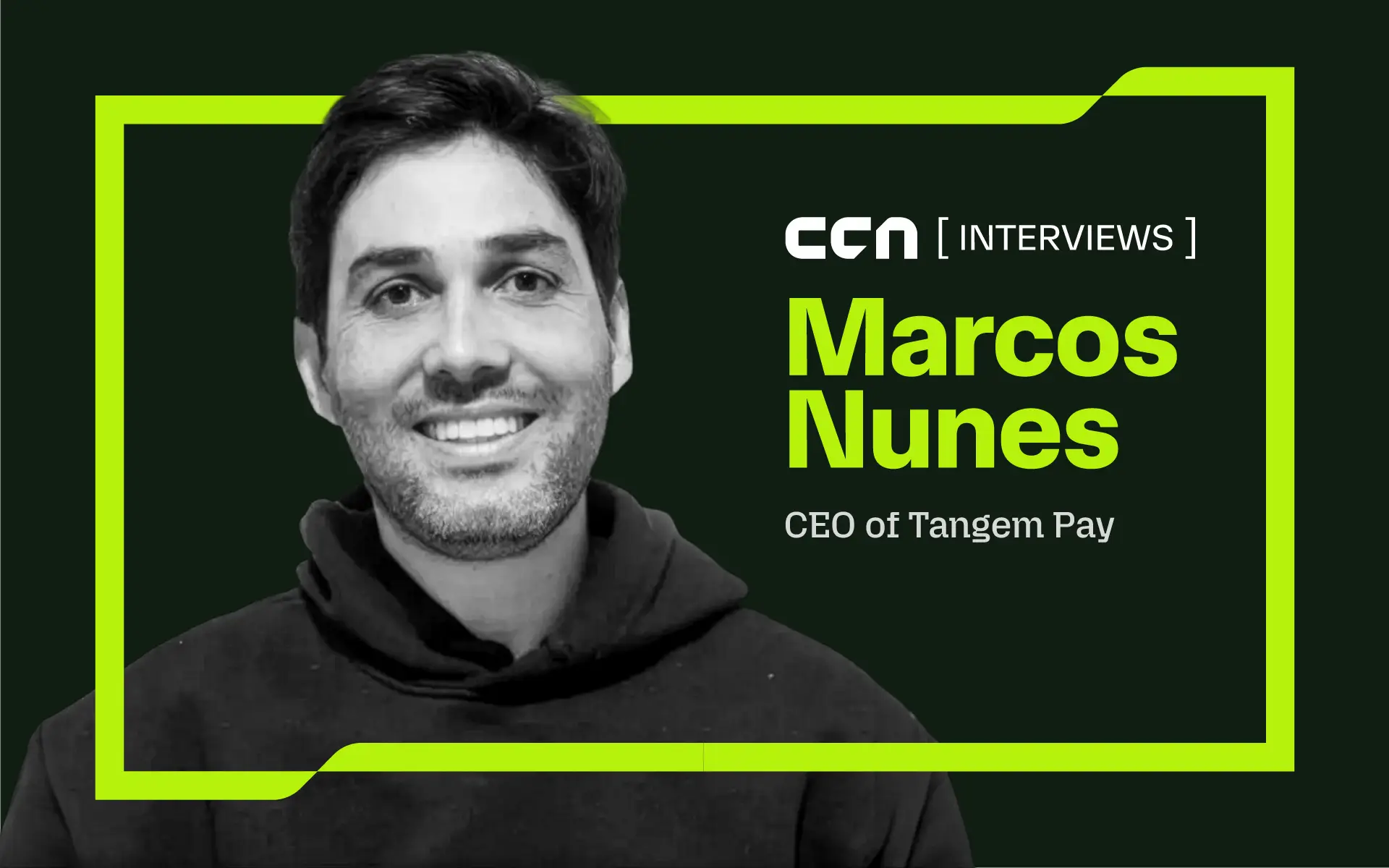
As traditional banks tighten controls and crypto firms race to simplify digital assets for the massesTangem Pay CEO Marcos Nunes is pitching a different future for money—one built entirely on access.
“I don’t believe in custody anymore,” Nunes told CCN.
“For practical reasons, you don’t get the max out of your money. And soon people will understand that.”
The payments veteran, who previously worked with UK fintech Teya, now leads Tangem Pay, a firm aiming to bridge self-custody crypto infrastructure with everyday payments.
Its ambition is ambitious but simple — to build a financial system flexible enough to serve “the 8 billion people out there.”
Tangem Pay’s Role Beyond Crypto
Nunes insists the company’s vision is not driven by crypto evangelism, but by user expectations shaped in traditional finance.
“I don’t think it’s about self-custody,” he said. “People need to move their funds. They want the ease of moving funds, they expect to be safe, and they expect the best return on their money — the lowest fees.”
At the core of Tangem Pay’s approach is what Nunes calls “composable finance,” in which users can mix and match financial services without relinquishing control over their assets.
“The only way to do this is with composable finance,” he said.
“You can associate your money with different providers and offers… and plug in what you like.”
But he suggested adoption at scale is not the immediate priority.
“If 5 billion or 1 billion or 5 million use it, it’s more about us building the brand and being capable of reaching out to everyone and explaining our offer than their interest,” he said.
Nunes argues that even if Tangem does not dominate the space, the broader shift toward composable finance is inevitable.
“Either with us or with someone like us, they will be in this composable space,” he said.
Rethinking The Role of Banks
Nunes frames Tangem’s strategy within a broader evolution of banking, which he divided into distinct generations — from physical branches to mobile apps and fintech platforms.
“The bank role of today… is about providing people with the access they need in order to do whatever they need at their own time,” he said.
But he argues current models remain fundamentally flawed.
“I take care of your money, I take a piece… and I give you a little piece from it,” he said. “That generation still uses the same old systems.”
Rather than replacing banks directly, Nunes believes firms like Tangem will gradually erode their relevance.
“I don’t think we’re replacing banks,” he said. “I think banks are losing their relevance by just providing their own offers and their own returns.”
Tangem Pay’s Early Traction and Growth
Since launching its payments offeringTangem has seen rapid adoption, according to Nunes.
“We surpassed several million in TPV in weeks,” he said. “It’s double-digit growth every week.”
The company had previously set a target of 10 million users by 2026, a goal Nunes says is tied to expanding its ecosystem beyond hardware wallets.
“We expect to reach the number because we want to expand the things that we’re doing within Tangem,” he said.
He added that demand for self-custody tools is increasing regardless of market conditions.
“If Bitcoin drops, people buy hardware wallets. If Bitcoin goes crazy, people buy hardware wallets,” he said. “People are getting more and more aware of the need for safe instruments.”
The Usability Challenge
Despite growth, Nunes acknowledged that crypto products remain too complex for mainstream adoption — a point he tests with his own family.
“That’s my dad. That’s my Homer Simpson,” he said. “I don’t think we’re close.”
He pointed to the fragmented user journey in crypto — involving deposits, swaps, bridging and spending — as a major barrier.
“There are too many steps still,” he said.
Tangem aims to abstract that complexity, allowing users to deposit and spend funds seamlessly without interacting directly with blockchain mechanics.
“They will just simply say, ‘I can deposit here, and then I can spend from this money,’” he said.
Unlike some crypto firms aiming to displace legacy payment networks, Tangem believes it is smart to work alongside them.
“Everyone who says I’m going to take Visa down underestimates the amount of money and effort,” Nunes said. “It will take generations.”
Instead, Tangem is integrating with established systems while leveraging blockchain, thereby improving efficiency.
“You don’t build infrastructure. You build the relevance to the end user,” he said.
Stablecoins and Regulation
Tangem’s use of USDC as a core settlement asset highlights the balance between decentralization and practicality.
“Money will always be under a real economy regulation,” Nunes said.
While acknowledging concerns about centralization, he said stablecoins are necessary to bridge crypto and traditional economies.
“You need certain digital assets that are talking to this spending orientation,” he said.
At the same time, Tangem is deliberately limiting complexity for users.
“USDC is not one USDC… there are many variations,” he said. “We’re limiting the number of currencies and networks to deliver that experience first.”
Hardware and The “Always-On” Wallet
Beyond software, Tangem is developing physical products, such as a payment ring designed to keep financial access literally at users’ fingertips.
“The keys to my wealth [are] in my hands at all times,” Nunes said. “It’s always with me.”
The wearable device reflects a broader shift toward constant, frictionless access to funds — without relying on phones or cards.
“It’s not about the card very soon,” he said. “It’s about spending… paying rent, paying bills, making money programmable and accessible.”
Security Trade-Offs
Designing wearable payment devices introduces new security challenges, requiring adaptations from traditional card systems.
“A card is already easy because you have contactless payments… there’s a lot of standards,” Nunes said. “A ring… has very different ways of interacting with devices.”
Still, he believes Tangem’s experience in both payments infrastructure and blockchain gives it an edge.
“We were able to bring the best of both sides,” he said.
Tangem Pay’s Transaction-Driven Model
Nunes views Tangem’s business model as fundamentally different from traditional banking, focusing on transaction volume rather than deposits.
“We’re in the business of transactions,” he said. “I can only succeed if I understand how to make users make more transactions.”
He compared this approach to Google’s ad-driven model.
“Google is about clicks,” he said. “We’re about transactions.”
The aim, he added, is to reduce fees to the point where users barely notice them.
“I need to charge very little… to the degree that people don’t realize there’s a cost,” he said.
Looking ahead, Nunes expects Tangem to evolve into a unified financial platform combining storage, investment and payments.
“In two years from now… ” It’s just Tangem,” he said. “A financial app that operates at your own speed, at your own time.”
In the longer term, he believes users will move beyond concerns about wallets and security toward more sophisticated financial optimization.
“It’s going to be about how you’re plugged into yields… and how granular that becomes,” he said.
For Nunes, the shift is already underway — and irreversible.
“We have reached the peak,” he said of traditional banking. “I don’t think it’s going to be acceptable anymore.”
Top Trending Crypto Articles

Kurt Robson is a London-based reporter at CCN, specialising in the fast-moving worlds of crypto and emerging technology. He began his career covering local news in Cornwall after graduating from Falmouth University with First Class Honours in Journalism. There, he cut his teeth on everything from council meetings to missing swans.
He quickly rose through the ranks to become a frontline journalist at several of the UK’s leading national newspapers. Over the years, he has interviewed musicians and celebrities, reported from courtrooms and crime scenes, and secured multiple front-page exclusives.
Following the upheaval of the COVID-19 pandemic, Kurt shifted his focus to technology journalism—just ahead of the AI boom. With a natural curiosity and a trained eye for emerging trends, he has found a new rhythm in reporting on innovation.
At CCN, Kurt’s work focuses on the cutting edge of crypto, blockchain, AI, and the evolving digital world. Drawing on his background in people-first reporting and his deep interest in disruptive tech, Kurt delivers stories that are insightful, entertaining, and human-centric.