

GnosisDAO’s GIP-151 passed with 215% of the required quorum, 49 votes representing a voting weight roughly 2.15 times the 75,000 GNO minimum threshold.
The proposal authorized a one-time pro rata treasury redemption, allowing GNO holders to surrender tokens in exchange for a proportional share of liquid treasury assets. A passed governance vote on a treasury of this size redefines what governance tokens can be used for.
Until now, a governance token’s value rested on a stack of soft arguments, such as control over protocol direction, fee switches that might get activated, and treasury grants that might boost network growth.
When a DAO can be voted to return assets to holders, the token functions as a probability-weighted claim on the balance sheet, regardless of how it is legally classified.
Background reporting on the earlier GIP-150 redemption push cited a GnosisDAO treasury of roughly $223 million, an estimated redemption value near $170 per GNO, and a market price around $132, a 27% discount.
Current DeFiLlama data put the total treasury near $228 millionwith approximately $68 million in major assets, $22 million in stablecoins, $117 million in own-token exposure, and $21 million in other positions.
Net of native token circularity, the liquid treasury sits at around $109 million. DeFi analyst Ignas put GNO at approximately $106 against roughly $115 in treasury value per token around the time of GIP-151’s passage.
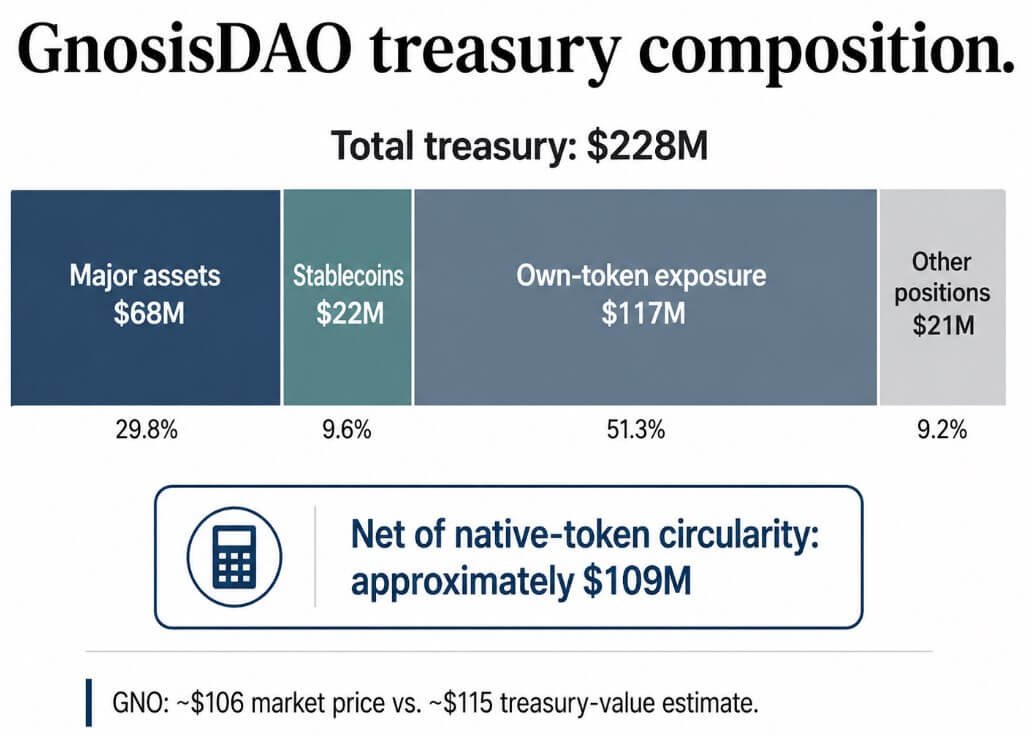
The trade that GIP-151 validates
That discount creates an investable structure consisting of buying tokens below the adjusted treasury value, accumulating governance influence, voting for redemption, and closing the gap.
That is the closed-end fund activism playbook applied to decentralized infrastructure, and Gnosis has now demonstrated it can be executed.
The Investment Company Institute put total closed-end fund assets at roughly $791 billion at year-end 2025, a market large enough to have given rise to decades of activist doctrine around NAV discounts, and DAO treasuries now sit inside that doctrine.
At a GNO price near $104 and a quorum threshold of 75,000 GNO, a position meeting the quorum costs approximately $7.8 million before slippage or opposition. GIP-151’s reported 215% quorum implies an actual voting weight of roughly 161,250 GNO, or about $16.8 million at that price.
Insider blocs, delegation structures, eligibility rules, and organized opposition all affect whether a given position wins a vote, but the numbers show why governance tokens over large liquid treasuries now carry a control premium the market has not historically priced.
The trade generates a straightforward screen: liquid treasury per token, market discount to adjusted NAV, quorum threshold, delegate concentration, foundation or multisig veto risk, treasury composition, and execution path.
DAOs with legally inaccessible, foundation-controlled, or native-token-heavy treasuries stay stranded at their discounts.
| Screen factor | Why it matters | What activists are looking for |
|---|---|---|
| Liquid treasury per token | Determines whether there is real redeemable value | Stablecoins, ETH, majors, low-haircut assets |
| Market discount to adjusted NAV | Defines the potential trade spread | Token price materially below treasury value |
| Quorum threshold | Measures how much voting weight is needed | Low enough threshold for coordinated holders |
| Delegate concentration | Shows whether votes can be influenced | Fragmented delegates or persuadable blocs |
| Insider / foundation control | Determines whether the treasury is practically reachable | Low veto risk from founders, foundations, multisigs |
| Treasury composition | Separates real NAV from paper NAV | Less native-token circularity, fewer illiquid bets |
| Execution path | Tests whether a vote can actually move assets | Onchain execution, clear legal wrapper, defined claims |
| Legal risk | Affects exchanges, holders, and future DAO design | Redemption framed as governance, not investment product |
How governance changes when capital enters the room
Traditional DAO governance assumes voters are builders, delegates, users, and participants with operational stakes in the protocol’s future.
Treasury activism imports a different voter through the NAV buyer, who holds governance tokens to extract balance-sheet value and has no particular interest in what the DAO builds next.
A governance forum that used to debate grant allocations, roadmap priorities, and fee-switch parameters now has to answer a prior question: should the DAO retain these assets and, if so, on what terms?
In the bull case, GIP-151 executes cleanly, with liquid assets distributed, illiquid positions handled through a claim token, and legal friction staying contained.
Governance tokens gain a credible new valuation anchor: the probability-weighted right to extract value from the treasury.
Other DAOs with liquid, transparent treasuries and permeable governance face immediate demands to justify why their tokens should trade below the value of the assets they govern. A clean execution could pull GNO toward or briefly above the $115 treasury-value estimate as remaining holders reprice the governance premium.
The bear case runs through execution delays, disputes over eligible supply, heavy haircuts on illiquid assets, or a treasury-defense campaign that exposes insider concentration, leading the market to discount both payout certainty and the post-redemption protocol’s capacity to function.
The wider risk for the DAO market is that several copycat redemption pushes fail simultaneously, demonstrating that most treasury discounts are structurally inaccessible, and the NAV-activism thesis deflates before it fully takes hold.
| Scenario | What has to happen | Likely GNO impact | Broader DAO market impact |
|---|---|---|---|
| Bull case | GIP-151 executes cleanly, liquid assets are distributed, legal friction stays limited | GNO trades closer to or above the ~$115 treasury-value estimate | DAO tokens with clean liquid treasuries reprice higher on redemption optionality |
| Base case | Redemption works, but with delays, haircuts, or limited participation | GNO trades around adjusted treasury value, not full headline NAV | Treasury-rich DAOs face pressure to explain reserves, spending, and governance control |
| Bear case | Execution disputes, eligibility fights, insider resistance, or heavy illiquid-asset haircuts | Market discounts payout certainty and post-redemption protocol value | Most DAO treasury discounts are treated as inaccessible |
| Black swan | Regulatory, exchange, or litigation pressure reframes redemption as security-like behavior | GNO and similar tokens face sharp legal/liquidity discount | Governance tokens split between “usable governance” and “fund-like treasury claim” buckets |
The legal exposure that follows
The SEC’s 2026 crypto guidance holds that a non-security crypto asset can still be sold as part of an investment contract when surrounding facts satisfy the Howey test: investment of money, common enterprise, expectation of profits, and reliance on the managerial efforts of others.
Pro-rata treasury redemption gives regulators cleaner facts to run that analysis.
Regulators can now ask more directly whether buyers hold a governance token to participate in protocol decisions or expect returns from a pooled treasury managed and distributed by others.
Legal risk rises sharply if projects, delegates, activists, or market materials frame tokens explicitly as treasury claims.
The distinction between “governance token that enables redemption” and “redeemable treasury interest” is the line that litigation and enforcement will contest.
A second exposure follows from treasury composition. The Investment Company Act applies to issuers whose primary business resembles investing, reinvesting, or holding securities, with a 40% investment-securities threshold embedded in the statute.
A passed redemption mechanism raises the question of whether a DAO that holds ETH, stablecoinstokenized securities, RWAs, and LP positions, and can be voted to distribute them pro rata, starts to resemble a redeemable asset pool more than an operating network.
The CLARITY Act debate adds a structural wrinkle, as the Senate bill distinguishes between decentralized and centralized platforms, with the latter subject to financial institution-style obligations, including transaction monitoring and suspicious-activity reporting.
A DAO can be genuinely decentralized at the protocol layer while concentrating treasury control in insiders, multisigs, or delegate blocs. Gnosis provides regulators with a real-world example of that gap.
The DeFi spillover
DAO treasuries fund liquidity programs, grants, market-making budgets, protocol contributors, and LP positions.
Redemption votes, whether isolated or part of an activist norm, force treasuries to liquidate assets, such as stablecoin outflows, ETH sales, unwound LP positions, and cut incentive programs.
The total stablecoin market cap is near $314 billionwith Ethereum holding roughly half, according to DeFiLlama. With the Fed holding its target range at 3.50% to 3.75%the opportunity cost of idle DAO stablecoin reserves is quantifiable and easy to argue in a governance forum.
The risk from Gnosis compounds if five or ten treasury-rich DAOs simultaneously face coordinated redemption campaigns, because the resulting asset sales and incentive cuts run across protocols that share liquidity, validators, and grant recipients.
Rook DAO, Fei/Tribe, and Aragon each demonstrated that DAO treasury conflicts can be resolved through redemption structures.
Aragon’s roughly $115 million ANT redemption came after a protracted governance fight, which the foundation resolved by returning capital to ANT holders. GIP-151 arrived by passing through standard governance, above quorum, without the DAO visibly collapsing first.
That procedural route converts a pattern of isolated governance crises into a repeatable strategic tool.
Every DAO governing a treasury larger than its market cap now trades at a discount that serves as an activist target. Whether DAO structures prove resilient to that, and whether US regulators settle the legal question before the market does, are the forward-looking variables that Gnosis left open.