
Introduction
The internet transformed how the world communicates, shares information, and conducts business. Yet, despite these advances, financial infrastructure remains fragmented, permissioned, and heavily dependent on centralized institutions. Payments can take days to settle, billions remain unbanked, and access to financial services often depends on geography, identity, or institutional approval.
Decentralized Finance (DeFi) is changing that narrative.
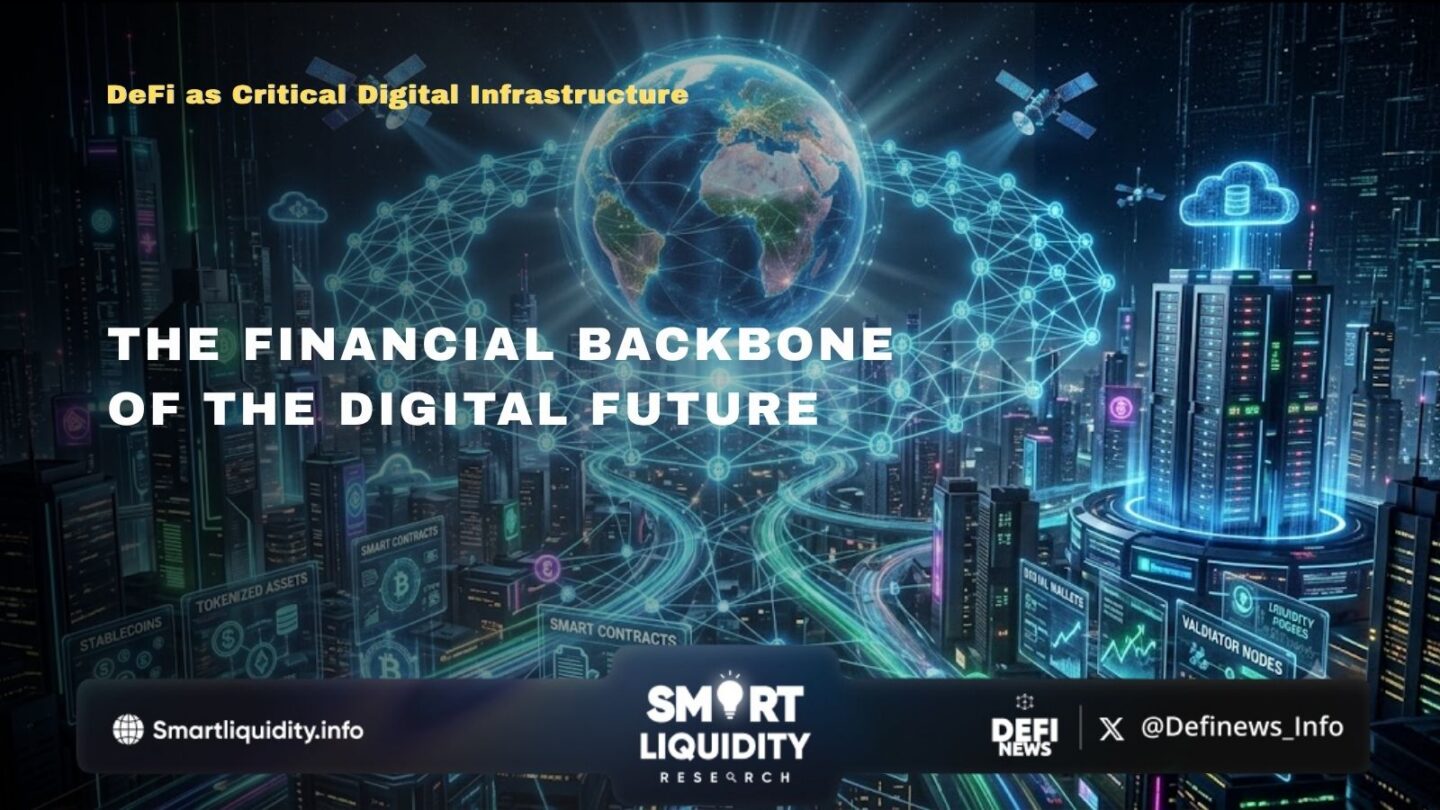
Rather than simply offering an alternative to traditional banking, DeFi is evolving into critical digital infrastructure—a foundational financial layer that anyone can access, build upon, and integrate into the next generation of applications. Just as the internet became essential infrastructure for information, DeFi is becoming essential infrastructure for value.
What Makes Infrastructure “Critical”?
Critical infrastructure refers to systems that society depends on every day. Electricity grids, telecommunications networks, transportation systems, and cloud computing platforms all fall into this category because they enable countless services to function.
DeFi increasingly shares these characteristics:
- Operates continuously without business hours
- Accessible globally through an internet connection
- Open for developers to build on
- Resistant to single points of failure
- Transparent and verifiable
- Programmable by design
Instead of replacing banks outright, DeFi provides the financial operating system that applications, businesses, and even governments can leverage.
Financial Services Become Internet Primitives
One of DeFi’s greatest innovations is transforming financial functions into programmable building blocks.
Developers no longer need to build payment networks, lending systems, exchanges, or settlement infrastructure from scratch.
Instead, they can integrate existing DeFi protocols much like developers use cloud storage or payment APIs today.
These financial primitives include:
- Stablecoin payments
- Decentralized lending
- Automated exchanges
- On-chain collateral management
- Yield-generating vaults
- Cross-chain asset transfers
- Tokenized real-world assets
This composability dramatically accelerates innovation while reducing infrastructure costs.
Always-On Global Finance
Traditional financial infrastructure still operates within numerous constraints:
- Banking hours
- National borders
- Multiple intermediaries
- Settlement delays
- High remittance costs
- Manual reconciliation
DeFi removes many of these limitations.
Transactions settle around the clock.
Capital moves continuously.
Applications operate regardless of weekends or holidays.
This always-on availability is particularly valuable for global businesses, remote workers, digital creators, and international commerce.
Stablecoins: The Infrastructure Layer for Digital Payments
Stablecoins have quietly become one of DeFi’s most important components.
Rather than focusing on speculation, stablecoins enable:
- International payroll
- Merchant payments
- Cross-border settlements
- Treasury management
- E-commerce transactions
- Institutional liquidity
For many users, stablecoins represent their first interaction with blockchain technology—not because they are interested in crypto, but because they need faster, cheaper, and more reliable payments.
As adoption grows, stablecoins increasingly resemble digital public utilities for money movement.
Open Infrastructure Encourages Competition
Traditional financial systems often rely on closed networks where innovation depends on permission from intermediaries.
DeFi changes this dynamic.
Anyone can build:
- Wallets
- Trading platforms
- Lending markets
- Insurance protocols
- Payment applications
- Asset management tools
Developers compete on user experience rather than exclusive access to infrastructure.
This openness creates a healthier ecosystem where innovation moves faster, and users benefit from better services.
Programmable Money Changes Everything
Money is no longer limited to being stored or transferred.
With smart contracts, money becomes programmable.
Examples include:
- Automatic revenue sharing
- Instant royalty payments
- Escrow without intermediaries
- Streaming salaries by the second
- Automated subscriptions
- Conditional business payments
- Machine-to-machine commerce
As artificial intelligence and the Internet of Things expand, programmable financial infrastructure becomes increasingly important.
Machines will eventually need financial systems that operate autonomously.
DeFi is uniquely positioned to support this future.
Infrastructure for Tokenized Real-World Assets
Governments, financial institutions, and enterprises are exploring tokenization at an unprecedented pace.
Assets that can be represented on-chain include:
- Government bonds
- Treasury bills
- Corporate debt
- Real estate
- Commodities
- Private credit
- Carbon credits
DeFi provides the infrastructure where these assets can be:
- Traded
- Borrowed against
- Used as collateral
- Fractionalized
- Settled instantly
Rather than building entirely new financial rails, institutions increasingly connect to existing decentralized infrastructure.
Resilience Through Decentralization
Critical infrastructure must remain operational even under stress.
Traditional systems face risks such as:
- Data center outages
- Banking failures
- Political instability
- Regional disruptions
- Single points of failure
Public blockchain networks distribute operations across thousands of independent nodes worldwide.
Although no system is perfect, decentralization significantly reduces dependence on any single operator.
This resilience is becoming increasingly valuable in an interconnected global economy.
Challenges Before DeFi Can Become Global Infrastructure
Despite remarkable progress, several challenges remain.
Scalability
Infrastructure must support millions—or even billions—of users without sacrificing performance.
User Experience
Wallet management, onboarding, and security remain difficult for many newcomers.
Regulatory Clarity
Governments continue developing frameworks that balance innovation with consumer protection.
Security
Smart contract vulnerabilities, exploits, and protocol risks must continue to decline through better development practices and auditing.
Interoperability
The future financial system will likely span multiple blockchains rather than a single dominant network.
The Infrastructure We Don’t Notice
The most successful infrastructure often becomes invisible.
Few people think about:
- DNS when browsing websites.
- TCP/IP when sending emails.
- Cloud servers when using mobile apps.
Similarly, future users may never realize they’re using DeFi.
They’ll simply:
- Send money instantly.
- Receive salaries globally.
- Trade tokenized assets.
- Earn yield automatically.
- Purchase digital goods.
- Access financial services from any device.
The blockchain becomes invisible while the experience becomes seamless.
Conclusion
DeFi is evolving far beyond decentralized exchanges and yield farming. It is becoming the programmable financial infrastructure that can power digital commerce, tokenized assets, global payments, AI-driven economies, and next-generation internet applications.
The future of finance may not be defined by who owns the infrastructure, but by who can build on top of it. In that future, DeFi serves as the open, resilient, and interoperable foundation—enabling innovation at internet scale.
As digital economies continue to expand, the most important question may no longer be whether DeFi can compete with traditional finance, but whether tomorrow’s financial system can function efficiently without the open infrastructure that DeFi provides.