
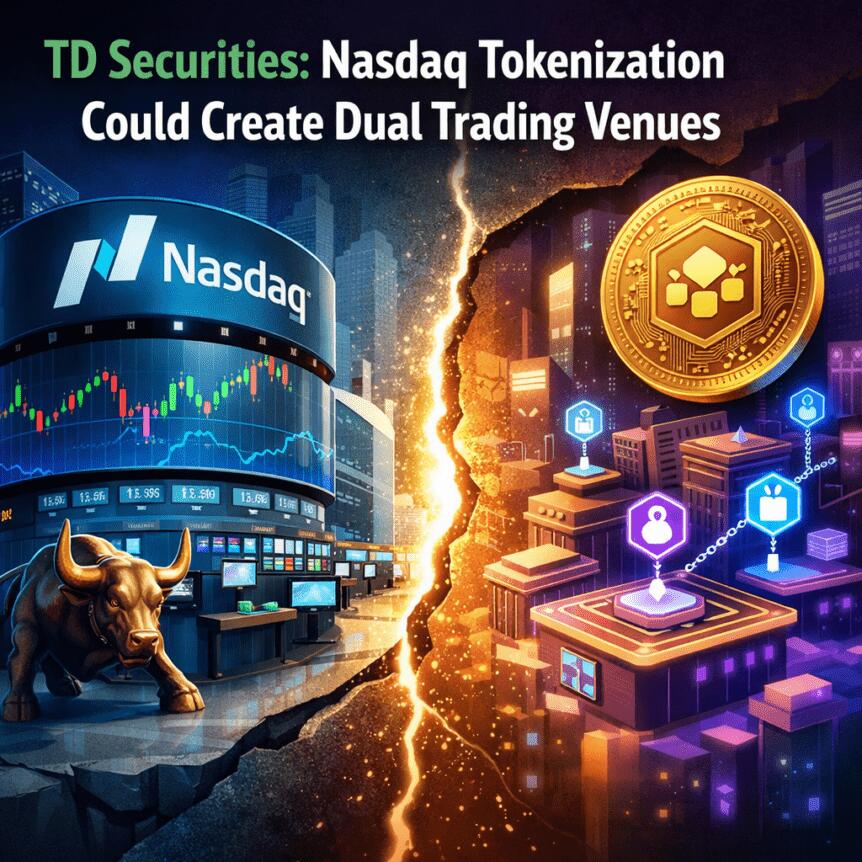
Nasdaq’s drive to tokenize equities could reshape capital markets by introducing a two-tier landscape where regulated US exchanges sit alongside blockchain-based trading venues. A TD Securities note suggests the move may create parallel systems capable of splintering trading activity and producing price differences across platforms as tokenized stocks gain traction.
The bank’s analysis highlights Nasdaq’s parallel push, joining NYSE’s tokenization efforts, to advance three main tracks: modernizing post-trade settlement for tokenized assets, enabling issuances of tokenized shares, and extending trading to offshore venues such as Kraken. Taken together, these efforts could lead to a split market where one stream operates within the traditional US regulatory framework and another on offshore, blockchain-enabled platforms.
TD Securities cautions that offshore venues—while backed by real securities—could escape the American regulatory perimeter. If tokenized shares trade on these platforms, prices could diverge from those on standard US venues, complicating price discovery and potentially siphoning activity away from established exchanges. Cointelegraph reached out to TD Securities for comment but did not receive a response in time for publication.
Key takeaways
- Nasdaq’s tokenization strategy comprises three parallel efforts: post-trade settlement upgrades, tokenized equity issuance, and offshore trading support on platforms such as Kraken.
- The initiatives could yield a two-tier market: a regulated US market and an offshore, blockchain-based trading ecosystem, with potential price differentials between venues.
- Tokenized equities are gaining real traction, as shown by Kraken’s xStocks platform, which has surpassed $25 billion in cumulative trading volume and grown about 150% since November.
- Trading across multiple venues may create 24/7 access and broader round‑the‑clock liquidity, but it also introduces new risks around activity concentration and inconsistent pricing.
- Industry context shows broader momentum: Coinbase expanding tokenized stock offerings and NYSE’s collaboration with Securitize to explore 24/7 tokenized securities, signaling growing competition for traditional equity trading.
Nasdaq’s tokenization roadmap could redefine how equities are traded
The TD Securities note frames Nasdaq’s tokenization ambitions as a triad of initiatives designed to integrate blockchain-based trading into mainstream markets without waiting for a single, wholesale overhaul of market structure. First, settlement modernization would adapt clearing and custody processes to handle tokenized shares more efficiently after trade execution. This is a prerequisite for reliable, scalable on-chain settlement that can coexist with existing post-trade infrastructure.
Second, Nasdaq is examining mechanisms to issue tokenized shares themselves, potentially enabling corporate issuers to digitalize equity ownership in a way that can be traded on both traditional venues and compatible blockchain networks. Third, the exchange is said to be exploring offshore trading opportunities, effectively enabling tokenized equities to be traded on platforms outside the domestic regulatory perimeter, with Kraken cited as an example of such a venue.
Taken together, these moves imply a market where the “same” stock could be represented and traded across different rails. In practice, that means investors might access tokenized versions of equities in a 24/7 framework outside normal exchange hours, while the same underlying share remains available through standard US listings during regular hours.
For market participants, the implications are twofold. On one hand, the potential for continuous liquidity and new liquidity pools could improve access and price discovery in certain scenarios. On the other hand, the emergence of parallel offshore venues raises questions about regulatory alignment, investor protection, and the coherence of pricing across ecosystems.
Markets adapting to tokenized competition and regulatory risk
Today’s crypto-enabled trading ecosystems already feature a growing set of tokenized equities, with traders increasingly engaging a broader, cross-border audience. Cointelegraph reported that Kraken’s xStocks platform, which provides tokenized versions of publicly traded shares on blockchain-based venues, has surpassed $25 billion in cumulative trading volume, reflecting around 150% growth since November. The momentum underscores a real appetite for around-the-clock access to equities in a tokenized format, even as traditional venues continue to operate within their established hours and rules.
Behind this expansion sits a broader industry trend: the push by major exchanges to experiment with tokenization while contemplating how to regulate, govern, and ultimately integrate these assets with existing equity markets. The NYSE, for its part, has been pursuing tokenization through a partnership with Securitize to develop a platform for tokenized securities that could support extended or non-traditional trading hours. This collaboration mirrors a wider market push toward an “everything exchange” model, where tokenized assets compete for space alongside conventional securities.
From an investor perspective, the emergence of multiple venues tied to the same underlying asset could alter how portfolios are constructed and how risk is assessed. If tokenized shares trade at different prices across regulated and offshore platforms, traders may need to track multiple price signals and navigate potential arbitrage opportunities. The prospect of 24/7 trading, while attractive for liquidity and access, also introduces new layers of risk—especially if regulatory guardrails diverge between venues or jurisdictions.
Regulators will likely weigh the benefits of broader access and innovation against the need to preserve investor protections and market integrity. The current conversation highlights a tension between accelerating tokenization and maintaining a cohesive, transparent market framework. As market participants deploy more tokenized offerings, observers will be looking for alignment in settlement standards, custody controls, and cross-venue price discovery mechanisms.
Beyond Nasdaq and NYSE, other industry players have already begun positioning for tokenized trading. Coinbase has pushed into tokenized stock offerings as part of an “everything exchange” strategy, signaling a competitive push from crypto-native platforms into equity trading. In parallel, NYSE’s collaboration with Securitize points to a broader ecosystem of tokenized securities designed to enable more flexible trading paradigms, including around-the-clock access that challenges traditional market hours.
What remains uncertain is how regulators will reconcile these parallel rails. Will there be harmonized standards for settlement and custody across on-chain and off-chain venues? How will investor protections translate when trading occurs on offshore platforms? And how quickly will price discoveries across venues converge or diverge under a regime of tokenized equities?
In interviews and briefings, contributors like Reid Noch of TD Securities emphasize that while tokenization promises to broaden access and liquidity, it also introduces new complexities. The coming months are likely to bring more concrete regulatory guidance, clearer cross-venue interoperability standards, and perhaps pilot programs that test tokenized trading in controlled environments before any broad rollout.
As the market digests these developments, investors and traders should monitor several cues: the pace at which settlement and custody workflows adapt to tokenized assets, the degree of cross-venue price convergence, and the regulatory responses that could either unlock or constrain offshore trading activity. The balance between innovation and oversight will shape how tokenized equities evolve from experimental concepts into mainstream instruments.
Readers should watch for updates from Nasdaq and NYSE on timing and scope of tokenized trading pilots, along with any new clarity from US regulators on cross-border trading and tokenized securities. The coming months could reveal whether tokenization simply augments existing markets or fundamentally reconfigures how equities are priced, traded, and owned.