

GameStop (GME) management said in January that the company is looking at a major acquisition. This update was unusual, as it came directly from CEO Ryan Cohen, who said a “very, very, very big” acquisition was in the cards. GameStop holds nearly $9 billion in cash, so Cohen’s comments generated excitement. Since the aim of this acquisition is to generate gains through efficiency and transformation, it’s clear that GameStop will look to acquire an entity in distress. Cohen said GameStop is targeting a company with a “sleepy management team.”
There is speculation now that the acquisition target in question could be Best Buy (BBY). But this is just speculation, as GameStop has not confirmed anything. A research note from Don Bilson of Gordon Haskett Research Advisors is what’s creating all the noise, despite not explicitly stating the news. One reason for this speculation is GameStop’s latest 10k filing, wherein the company reported that it added $700 million to a bank account pledged as collateral for some existing transactions.
Irrespective of whether GameStop is buying Best Buy, one thing is quite certain: there will be noise around GME stock, there will be volatility, and as a result retail traders will be flocking to buy shares in hopes for a rally.
GameStop is a global retailer of video games, consoles, and collectibles operating both online and in physical stores. Founded in 1996, GameStop is headquartered in Grapevine, Texas.
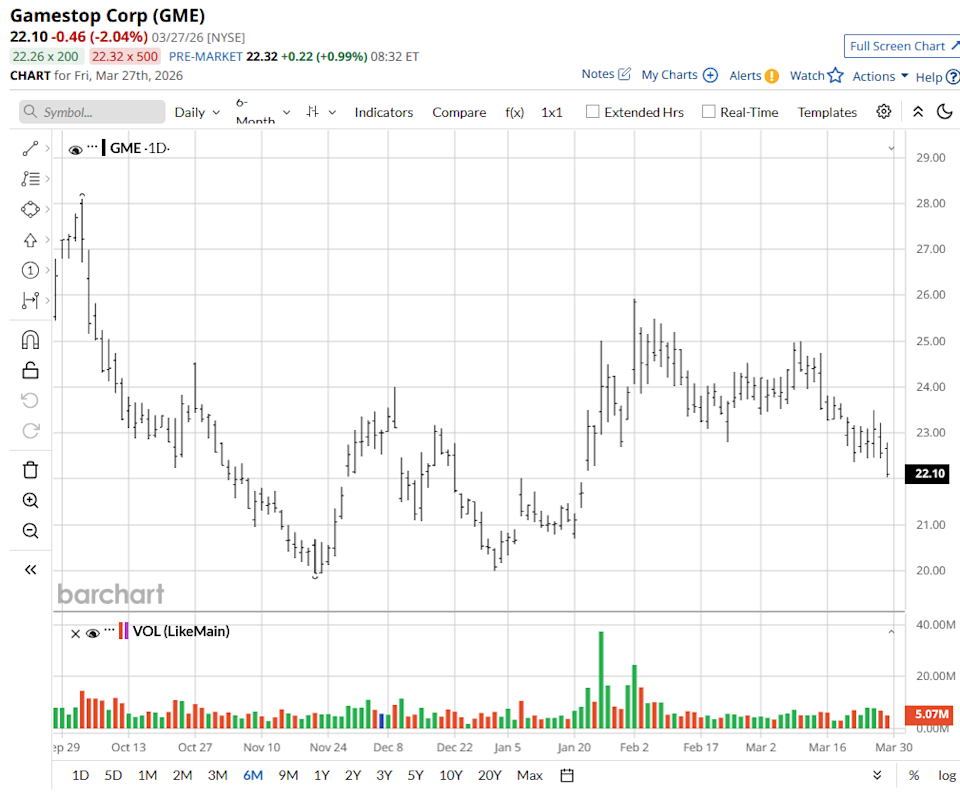
The last 12 months have returned only 5% for shareholders, although that’s hardly why traders buy GME stock. They trade it for volatility, and there has been no shortage of that. After climbing substantially in 2024, the stock gave half of its gains back within a few months, only to go up again and then back to the same level in the first half of 2025. There has been relative stability since, but the returns have been muted.
GameStop’s ability to acquire a big company stems from its healthy cash position. The company holds $6.3 billion in cash and cash equivalents, and then some more as marketable securities, which is a healthy position for any acquisition. There is no short-term debt, and the current assets easily cover the long-term debt of $4.1 billion. The company has also generated consistent free cash flow, culminating in $597 million in the most recent quarter. GameStop gets labelled as a dying business, but the books are healthier than the sentiment suggests.
