
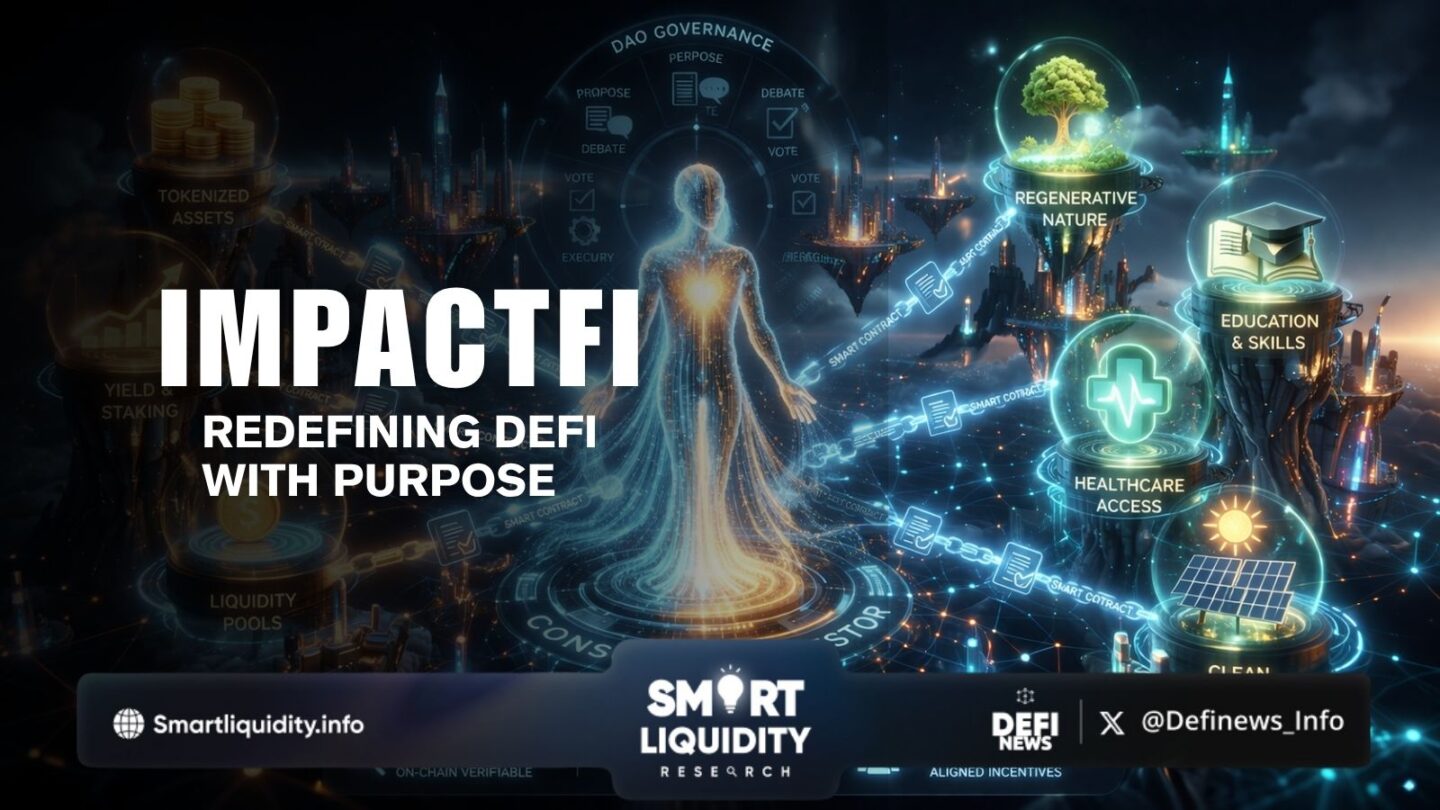
The decentralized finance (DeFi) revolution promised a financial system without banks, borders, or gatekeepers. And to be fair, it delivered. Today, anyone with an internet connection can lend, borrow, trade, and earn yield through blockchain-based protocols.
But here’s the uncomfortable truth: most of DeFi ended up optimizing for profit… not purpose.
Enter ImpactFi—the evolution of DeFi that merges financial returns with real-world social and environmental impact. It’s not just about making money anymore; it’s about making money matter.
What Is ImpactFi?
ImpactFi sits at the intersection of DeFi and impact investing.
Impact investing itself focuses on generating measurable social or environmental benefits alongside financial returns.
Now combine that with blockchain—and you get a transparent, programmable, and decentralized system that aligns capital with global impact.
In simple terms:
ImpactFi = DeFi + Purpose
Instead of yield farming for pure profit, users can now earn while funding renewable energy, education, healthcare, or climate initiatives.
Why Traditional Finance Fell Short
Before ImpactFi, impact investing faced several bottlenecks:
- High entry barriers (big money only)
- Slow decision-making
- Lack of transparency
- Limited community involvement
Even with trillions flowing into the sector, capital distribution remained inefficient and often disconnected from the communities it aimed to serve.
ImpactFi fixes this—with code.
The Core Pillars of ImpactFi
1. Transparency Through Blockchain
Every transaction, allocation, and outcome is recorded on-chain.
No more vague “impact reports.”
No more “trust us” fund managers.
With blockchain:
- You can verify where funds go
- Track outcomes in real time
- Audit impact metrics transparently
This solves one of the biggest issues in traditional impact investing—accountability.
2. Smart Contracts = Automated Impact
Smart contracts power DeFi by executing agreements without intermediaries. ImpactFi takes this further.
For example:
- A portion of the yield is automatically redirected to climate projects
- Donations are triggered by on-chain events
- Funds are released only when impact milestones are met
This creates programmable philanthropy—no human bias, no delays.
3. Community Governance via DAOs
ImpactFi platforms often use DAOs (Decentralized Autonomous Organizations).
Instead of a centralized fund manager:
- Investors, communities, and stakeholders vote on decisions
- Governance tokens give real influence
- Funding decisions are democratized
This flips the script:
The people affected by investments finally have a say in them.
4. Impact Yield Farming
A standout innovation is impact yield farming.
Traditionally:
- You stake → you earn rewards
In ImpactFi:
- You stake → you earn and fund real-world impact
Some protocols even split yields:
- Part goes to the user
- Part goes to social/environmental causes via smart contracts
It’s like earning passive income… with a conscience.
5. Financial Inclusion at Scale
DeFi already removes intermediaries, making finance accessible globally.
ImpactFi extends this by:
- Funding underserved communities
- Supporting microfinance through decentralized systems
- Enabling grassroots participation in investment decisions
This is where things get powerful:
ImpactFi doesn’t just redistribute wealth—it redistributes opportunity.
How ImpactFi Is Changing DeFi Itself
ImpactFi isn’t just a niche—it’s reshaping the entire DeFi narrative.
From Speculation → Sustainability
DeFi has often been criticized for being overly speculative. ImpactFi introduces long-term, mission-driven capital allocation.
From Whales → Communities
Governance is shifting from large token holders to broader stakeholder groups via DAO models.
From Yield → Purpose
Yield is no longer the only KPI. Now we measure:
- Carbon offset
- Social impact
- Community development
Real-World Use Cases
ImpactFi is already being applied in:
- 🌱 Climate finance (carbon credits, reforestation)
- 🏥 Healthcare funding in underserved regions
- 📚 Education access through decentralized grants
- 🌍 Local economic development via community DAOs
Blockchain even enables faster capital flow by simplifying the verification and tracking of outcomes.
Challenges (Because Nothing Is Perfect)
Let’s not pretend this is all sunshine and green candles:
- Impact measurement is still evolving
- Regulatory uncertainty remains
- Greenwashing risk exists (yes, even on-chain)
- User experience is still… very crypto
But compared to traditional systems?
ImpactFi is already leagues ahead in transparency and efficiency.
The Future of ImpactFi
The impact investing market is projected to grow massively in the coming years, and decentralized models are accelerating that shift.
We’re heading toward a world where:
- Every transaction has a traceable impact
- Capital allocation is community-driven
- Financial systems are aligned with global sustainability goals
In other words:
Finance stops being neutral—and starts being intentional.
Conclusive
ImpactFi is what happens when DeFi grows up.
It keeps the best parts—permissionless access, transparency, automation—and adds something DeFi desperately needed:
a reason beyond profit.
And if DeFi was about removing middlemen…
ImpactFi is about removing meaninglessness.