

Nuvei agreed to buy Payoneer for $2.75 billion in cash in a deal centered on money movement through merchant acquiring, payouts, FX, cards, risk controls, and licenses.
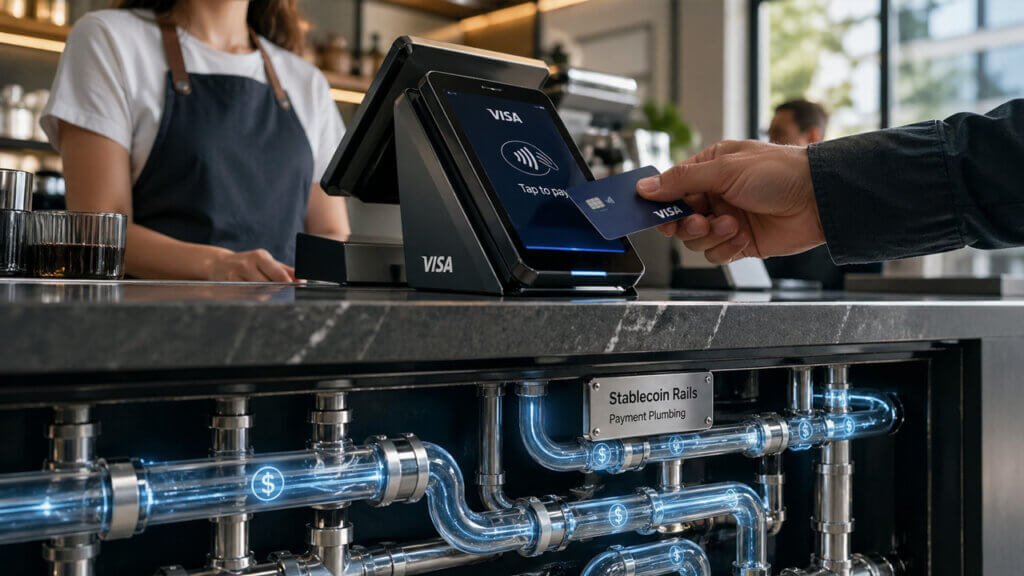
The companies also placed stablecoins inside that payment stack. That gives the deal its crypto significance: mainstream stablecoin use may run through processors that already own merchant relationships, local approvals, fraud controls, FX tools, and payout networks.
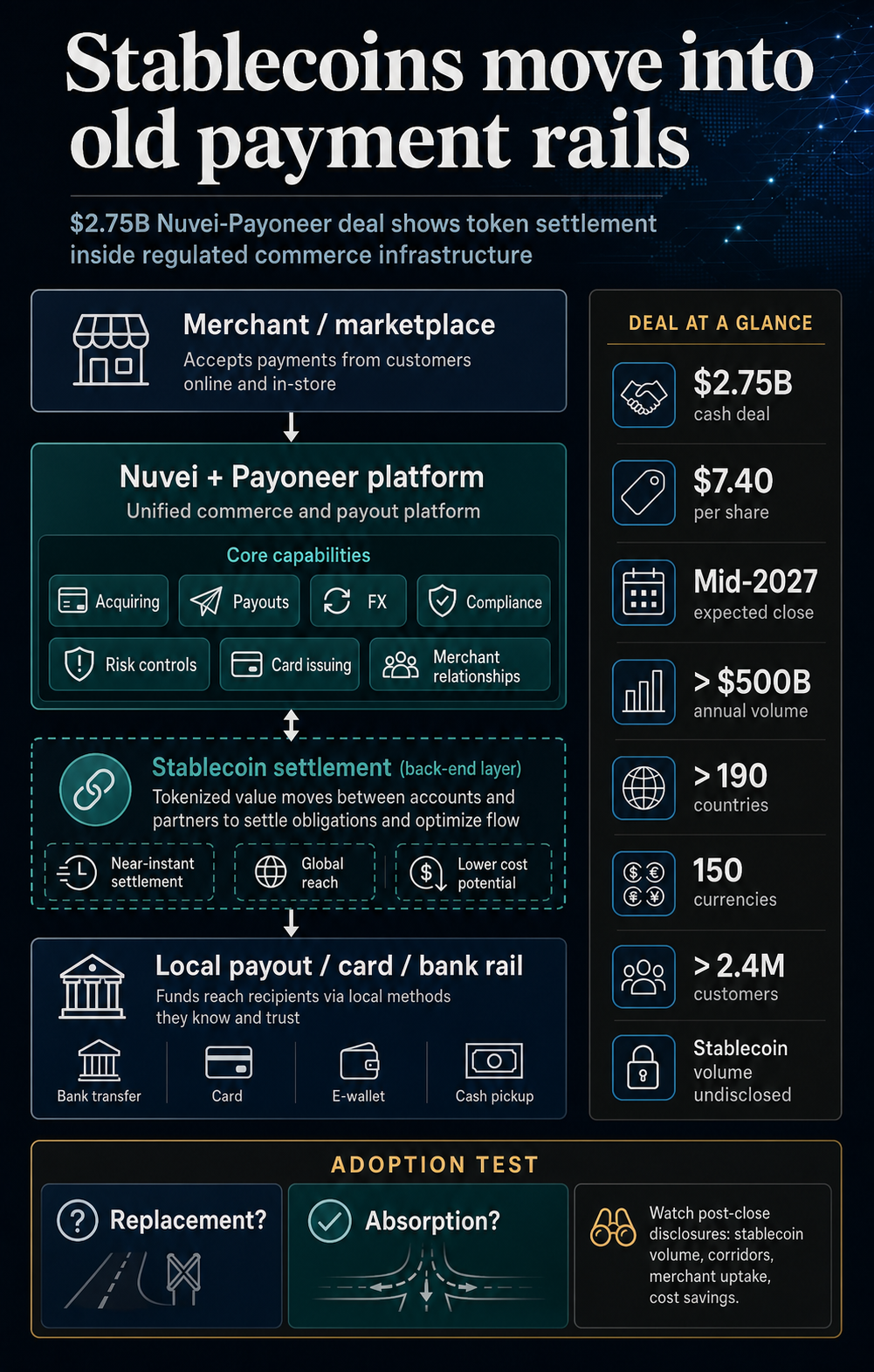
Nuvei announced June 15 that it would acquire all outstanding Payoneer shares for $7.40 per share in cash. The companies said the transaction values Payoneer at approximately $2.75 billion.
The deal is expected to close in mid-2027, subject to Payoneer shareholder approval, regulatory approvals, and other customary conditions.
At closing, Nuvei said the combined company is expected to generate approximately $3 billion in annual revenue and process more than $500 billion in annual payment volume for more than 2.4 million customers.
It also said the combined business would give companies a single partner to accept, hold, and move money, including stablecoin transactions, across more than 190 countries and territories.
The companies left stablecoin-specific volume undisclosed, which keeps the claim modest. For now, the transaction points to stablecoins becoming one capability inside regulated commerce infrastructure, while any volume forecast depends on future reporting.
Stablecoins sit inside the payment stack
The crypto signal in the Nuvei-Payoneer deal comes from distribution. Payoneer remains a cross-border payments and financial platform for businesses, marketplaces, contractors, and sellers that need to move money across countries and currencies.
That network is relevant for stablecoins because token settlement still has to meet the real-world requirements of business payments.
A dollar token can settle value quickly on-chain, but a merchant or platform still needs acceptance, risk screening, currency conversion, local payout rules, reconciliation, and usable accounts.
Those functions determine whether payment speed becomes a product companies can actually adopt.
Payoneer said its network adds cross-border payouts, multi-currency accounts, a banking network, and same-day or real-time settlement in more than 150 markets.
The company also pointed to regulatory assets, including licensing for online payment services in mainland China and in-principle authorization as a cross-border payment aggregator in India under the Reserve Bank of India’s framework.
Nuvei brings the merchant acceptance side. The company already describes its platform around global acquiring, alternative payment methods, issuing, currency management, fraud and risk controls, bank transfers, real-time payments, and crypto and digital assets.
Nuvei’s platform reach includes 150 currencies, while the combined company is expected to operate across more than 190 countries and territories.
Put together, the deal shows stablecoin functionality moving toward back-end payment routing.
A merchant may care less about whether settlement moves through a token, a bank transfer, a card network, or a local payout provider than about cost, settlement speed, compliance, and whether funds arrive where the business needs them.
| Confirmed element | Operational meaning | Constraint |
|---|---|---|
| $2.75 billion all-cash deal | Gives the analysis a concrete payments infrastructure peg | Closing remains pending |
| More than $500 billion expected annual payment volume | Shows the scale of payment-network distribution stablecoin functionality could plug into | Stablecoin-specific volume remains undisclosed |
| 190+ countries and territories | Makes local payout, FX, and compliance coverage central to the analysis | Nuvei’s 150-currency reach describes platform context |
| Stablecoin transactions named in deal language | Places token settlement inside mainstream payment infrastructure | Stablecoins are one capability inside the broader platform |
The Payoneer acquisition also extends work Nuvei had already started. Visa announced in 2023 that it was expanding USDC settlement capabilities with merchant acquirers Worldpay and Nuvei.
The program used Solana as well as Ethereum for settlement between partners. Those pilots remained limited, but they showed Nuvei operating where card settlement, merchant acquiring, and stablecoins overlap.
Nuvei then launched a blockchain payment solution in 2024 with Rain, BitGo, and Visa for Latin American merchants.
The company described a model in which businesses could use stablecoins for faster cross-border B2B payments and settlements while relying on existing card and payment infrastructure.
That history frames the Payoneer deal as distribution expansion. Payoneer gives Nuvei a wider base of cross-border customers, regulated markets, and payout relationships.
Stablecoin settlement can become more useful if it reaches that base through familiar payment products.
Compliance and distribution decide who owns the customer
The strongest version of the stablecoin thesis is that blockchain settlement can reduce delays, lower costs, and make cross-border payments easier.
The Nuvei-Payoneer deal leaves that thesis intact because it assumes stablecoins can be useful. It also shows how much non-token infrastructure still surrounds that usefulness.
A Federal Reserve staff analysis published in March said payment stablecoins can help address some cross-border payment frictions.
It also noted that FX liquidity, foreign-currency inventories, compliance checks, fiat conversion, and intermediaries may remain relevant in stablecoin-based cross-border models.
That maps closely onto what Nuvei is buying. Payoneer adds more than a payout interface.
Payoneer’s 2025 annual report describes a business that operates across payment services, money transmission, stored value, FX, compliance, bank and payment-service-provider relationships, and regulatory regimes.
Its India authorization is still in-principle, but the strategic asset is permissioned distribution across markets where rules, banking access, and trust shape payment adoption.
A stablecoin may move dollars across blockchains at any hour, but a corporate payment still has to enter and exit local financial systems.
Someone must handle identity checks, sanctions screening, tax documentation, local account access, chargebacks or disputes where applicable, and currency conversion.
If those functions sit around the token, processors that already own them can turn stablecoins into another settlement option while retaining the customer relationship.
Other payment networks are moving in the same direction. Mastercard said in March that it agreed to acquire BVNK, framing the deal around connecting on-chain payments and fiat rails.

That acquisition remains subject to regulatory review and other closing conditions, but the strategic language is similar. Stablecoins, tokenized deposits, and tokenized assets become usable when they plug into trusted payment networks.
CryptoSlate has tracked the same pattern in card payments.
A May analysis found that stablecoin-linked cards were routing most transactions through Visa, turning crypto balances into spending power through the same network stablecoins were expected to bypass.
Another CryptoSlate analysis argued that the control points for stablecoin payments are increasingly orchestration, compliance, reserves, FX management, and interoperability.
In that model, the token brand in front of the user plays a smaller role than the infrastructure behind it.
Nuvei’s Payoneer deal fits that map as market context while leaving execution to future disclosures.
If stablecoin payments scale through processors, acquirers, card networks, and cross-border payout providers, adoption can still be real while looking less like a clean exit from legacy finance.
Stablecoins can become a settlement and liquidity feature inside companies that already manage merchant access, local payout rules, and compliance.
The distinction changes who captures value in crypto payments.
If tokenized dollars become a back-end feature, the winners may be firms that control distribution and risk instead of issuers with the largest brands.
Merchants may choose the processor that gives them the best reach, cost, settlement speed, and local payout certainty, while the token itself becomes one part of the routing decision.
The adoption test comes after closing
The Nuvei-Payoneer deal leaves open whether stablecoins will eventually replace legacy payment rails.
It shows that large payment firms are preparing for a hybrid market in which stablecoins are packaged inside regulated money-movement platforms.
The next signals are concrete. The first is whether the transaction closes on the expected mid-2027 timeline after shareholder and regulatory review.
The second is whether Nuvei discloses stablecoin-specific payment volume, settlement corridors, merchant uptake, or cost savings after integration.
The third is whether businesses treat stablecoin settlement as a visible payment method or as hidden plumbing behind ordinary merchant and payout workflows.
The record points to absorption before replacement. Stablecoins are being packaged by mainstream payments companies.
If Nuvei can use Payoneer’s regulated distribution to make token settlement useful across merchants, platforms, and cross-border payouts, stablecoins may win payments by disappearing into the rails they were expected to bypass.