

Congress wants a task force for cryptocurrency theft months after the Justice Department disbanded NCET.
The proposal, introduced by Reps. Lance Gooden and Josh Gottheimer, would create a Federal Cryptocurrency Theft Task Force inside the Justice Department and place it under the attorney general or a designee, according to the bill text and a June 11 announcement from Gooden’s office.
That makes the bill more than another crime-and-crypto filing. It lands in the middle of Washington’s attempt to move digital asset markets away from enforcement-first uncertainty and toward clearer rules, while asking the same government to rebuild coordination for the thefts, hacks, scams, and coercion cases that keep hitting users.
The tension traces back to the DOJ’s April 2025 memowhich ended what Deputy Attorney General Todd Blanche called “regulation by prosecution.” The memo disbanded the National Cryptocurrency Enforcement Team, moved one DOJ unit away from cryptocurrency enforcement, and said prosecutors should focus on individual criminal misuse of digital assets rather than treating the industry itself as the target.
The new House bill preserves that market posture while drawing a line between market regulation and theft response: lighter policing of crypto markets paired with more coordination when someone loses funds.
What the bill would build
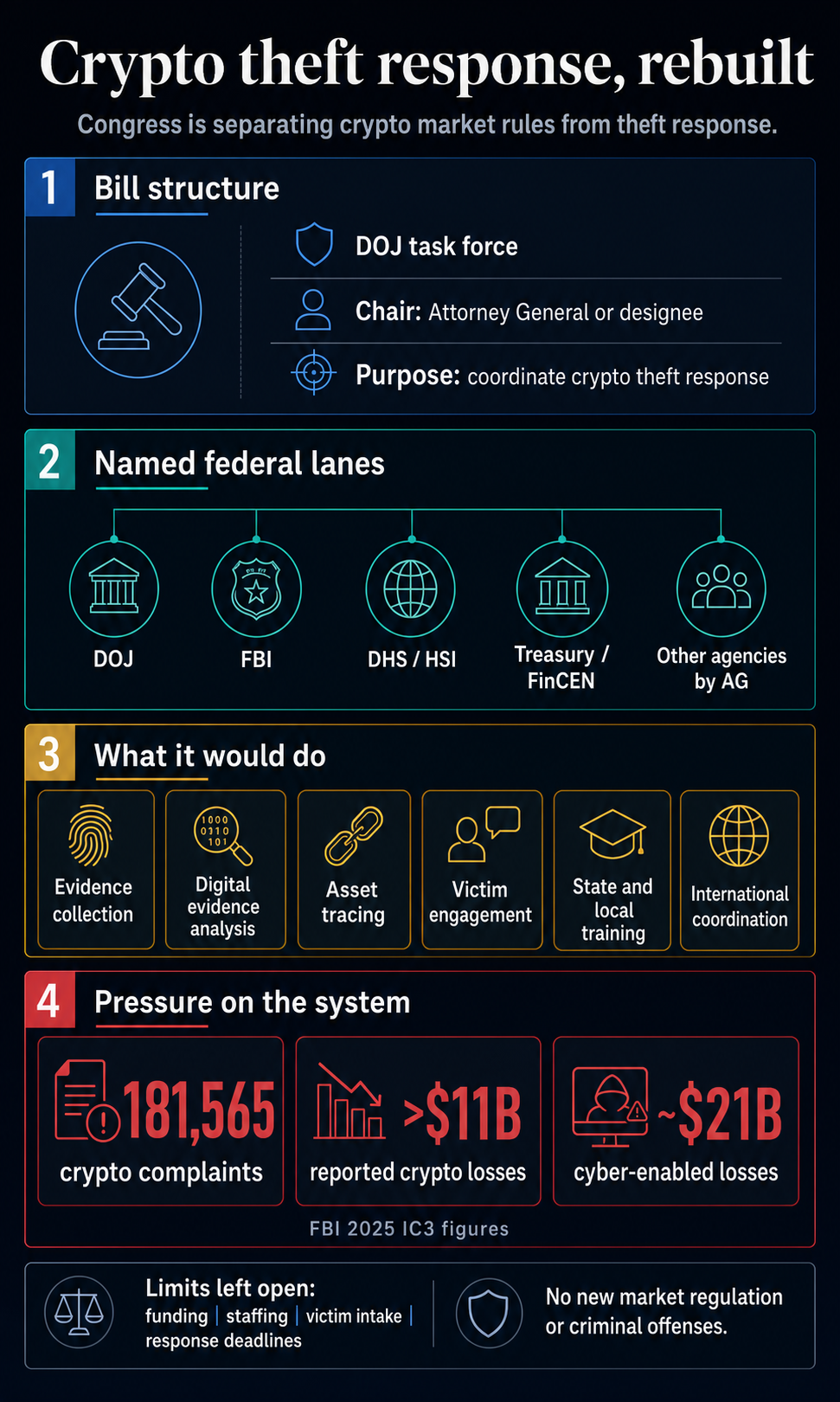
The Federal Cryptocurrency Theft Enforcement and Coordination Act would establish a task force within the DOJ and make it the primary federal coordination body for preventing, investigating, and prosecuting cryptocurrency theft and related criminal activity.
The bill text names senior representatives from the DOJ, the FBI, the Department of Homeland Security (including Homeland Security Investigations)and the Treasury (including FinCEN). It also lets the attorney general add other federal law-enforcement agencies as appropriate.
That wording matters because some summaries of the proposal point to a wider group of agencies; the visible bill text names those agencies and the attorney general’s catchall authority.
The task force’s duties are practical rather than regulatory. It would develop best practices for evidence collection, analysis of seized digital evidence, investigative techniques, asset tracing, and victim engagement.
It would also provide technical assistance, training, and guidance to state and local law enforcement agencies and prosecutors, share information with federal, state, local, Tribal, and territorial agencies, and coordinate with international partners when cases cross borders.
A small clause near the end is the policy hinge. The bill keeps cryptocurrency, digital asset markets, financial institutions, and financial products outside the task force’s regulatory reach.
It also leaves federal regulatory authority, the criminal code, and private rights of action unchanged.
| What the bill does | Outside the bill’s scope |
|---|---|
| Creates a DOJ task force for cryptocurrency theft coordination | Leaves crypto market regulation untouched |
| Builds federal, state, and local playbooks for evidence, tracing, and victims | Leaves criminal offenses unchanged |
| Requires annual reports on activity, trends, coordination, and recommended fixes | Leaves funding, staffing, and victim portal details open |
That structure gives the bill its political shape. Lawmakers are asking a different question from the exchange, mixer, wallet, and token-market fights: whether theft from crypto users needs a standing federal hub after DOJ dissolved the team most closely associated with specialized digital-asset crime work.
Why victim response is the pressure point
The strongest argument for the bill is the volume and variety of cases hitting victims and local authorities.
The FBI said its 2025 Internet Crime Report logged 181,565 complaints involving cryptocurrency and more than $11 billion in reported losses. Total reported cyber-enabled losses approached $21 billion.
Those figures stop short of showing that a new task force will recover more money, but they explain why Congress can separate the theft problem from the market-regulation debate.
A victim of a wallet drain, phishing scheme, exchange exploit, or coercive attack rarely experiences the system as one clean federal lane. Local police may lack blockchain tracing expertise. Prosecutors may need help preserving digital evidence.
Federal agencies may disagree over where the case fits. Private-sector firms may be the only parties able to quickly freeze, trace, or flag funds. In cross-border cases, the timeline for tracing assets can move faster than ordinary referral channels.
Recent CryptoSlate coverage illustrates different pressure points behind that coordination problem. The fight over the CLARITY Act has already pulled law-enforcement groups into market-structure negotiations because safe-harbor language can affect how prosecutors treat developers, infrastructure providers, and intermediaries.
DeFi exploit coverage has shown how a single flaw in shared code can affect multiple chains at once, turning a technical bug into a response problem across networks.

Physical attack coverage shows the offline side of the same threat, where coercion against holders can turn wallet security into a street-crime issue.
That is the part of the story the task-force bill tries to capture. Crypto crime now spans code exploits, scams, state-linked hacking, and offline coercion.
A general statement that DOJ remains able to prosecute crimes leaves unanswered whether a sheriff’s office, a victim, a federal agent, and a prosecutor can move quickly through the same case.
That mix gives the proposed training, evidence guidance, and outreach provisions their practical weight. A theft report may begin with a local officer, become a blockchain-tracing problem, and then turn into a sanctions, cyber, or cross-border question before funds move again.
The bill’s premise is that those handoffs need structure before the next victim shows up.
The bill’s test is capacity
The proposal still leaves a large question unanswered: whether coordination can become capacity.
The bill would require annual reports to Congress on the task force’s activities, emerging threats, coordination with state and local agencies, and recommended legislative or administrative fixes. It would also require outreach to state and local law enforcement, though participation by state, local, Tribal, and territorial governments would be voluntary.
Those provisions could matter if they produce a real playbook, reliable points of contact, and faster escalation for victims. They could also expose gaps Congress has yet to fund, including the number of agents, analysts, prosecutors, forensic specialists, and victim-support staff needed to make the task force more than a directory.
The bill leaves appropriations unspecified. It leaves victim intake, response deadlines, and work-sharing rules open. It creates a task-force model, while NCET operated as a dedicated DOJ enforcement team before the April 2025 shift.
That restraint is politically useful because it keeps the bill away from the broader crypto market fight. It is also the core weakness.
A task force can standardize evidence handling, training, and referrals, but only if agencies dedicate people, data access, and authority to the job.
The policy whiplash is real even though the bill text itself follows a coherent line. Washington can be friendlier to market access and still decide that stolen crypto needs a dedicated federal response.
The open question is whether Congress wants that response to be a specialized capability with resources behind it, or another formal label over a problem victims already experience as fragmented.