
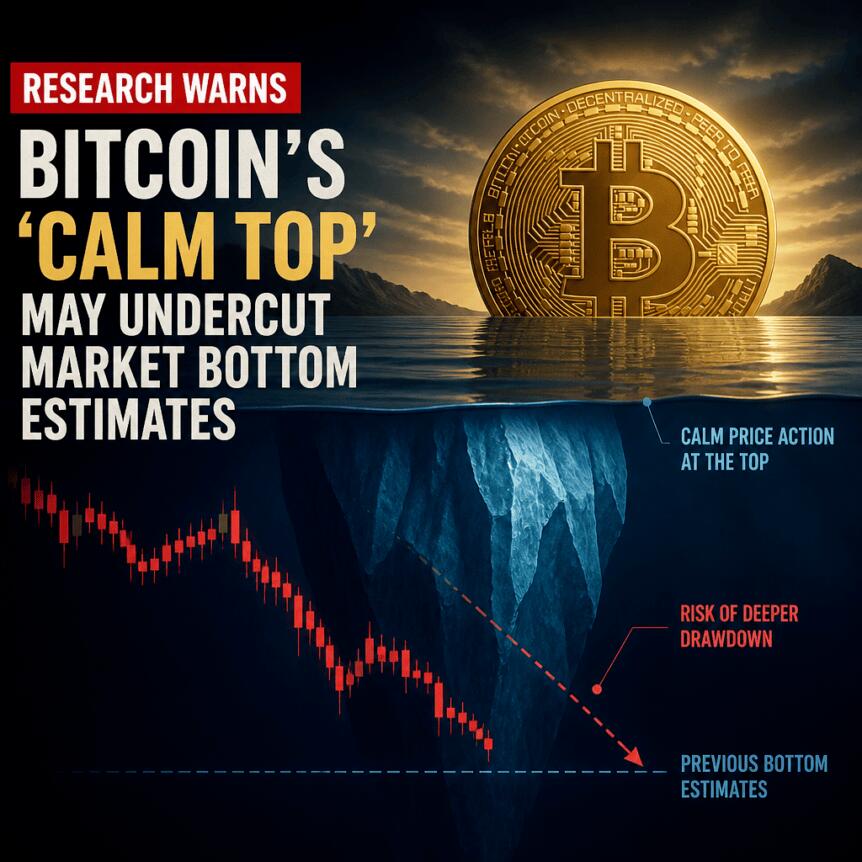
Bitcoin’s next major downside test may not have to sink as far as it did in earlier bear markets, according to a new analysis from Galaxy Digital. The firm argues that the asset’s realized-cost “floor” is currently higher than in previous cycles, implying that a cycle low could form at elevated price levels rather than through the deeper washouts seen historically.
In Galaxy’s base-case framing, the potential bottom sits between $40,000 and $46,000, with a tighter reference point tied to Bitcoin’s realized price at roughly $53,600. Galaxy head of research Alex Thorn also highlights that the current drawdown is still relatively young compared with prior cycle bottoms, while several commonly used bottoming indicators have yet to fully appear.
Key takeaways
- Galaxy Digital says Bitcoin’s “muted” cycle top could keep the network’s cost basis higher than prior bear markets, lifting the implied downside floor.
- The analysis places a base-case bottom range at $40,000 to $46,000, compared with a “washout” scenario of $30,000 to $37,000 and a shallower case near $51,000 to $54,000.
- Thorn estimates the cycle low could arrive sooner than in some prior downturns, as the current selloff is about eight months old versus 12–13 months in earlier cycles.
- CryptoQuant places BTC inside a historical value zone tied to bear-market lows, but demand indicators show a notable contraction.
Why Galaxy believes the downside floor may be higher
Galaxy’s research centers on a concept Thorn describes as “realized price” and the behavior of Bitcoin’s cycle from top to bottom. Thorn analyzed every Bitcoin cycle top and bottom and argues that the four-year rhythm continues to match historical timing closely, even as the magnitude of peak-to-trough declines has narrowed over recent years.
Across cycles, Galaxy notes that the drawdowns have compressed: from roughly mid-80% declines in earlier periods down to 77% in 2022 and around 51% in 2026. The implication is that the market is, so far, experiencing a less severe compression than past bear episodes.
A calmer top, fewer extreme signals
A central part of Thorn’s case is the behavior of the October 2025 cycle top. Galaxy claims that the topping environment was comparatively subdued: only two out of eleven traditional topping indicators triggered, and the Pi Cycle Top indicator reportedly failed to signal for the first time in this cycle framework.
Galaxy also points to MVRV (market value versus realized value), which Thorn says peaked at 2.29—below prior cycles, which ranged from 2.93 to 5.91. Thorn argues that this “calm top” matters because it affects where long-term holders’ cost basis is anchored.
“The key insight: a calm top RAISES the floor. Because October’s top was so muted, the network’s cost basis sits at 43.7% of ATH, vs ~34%, 21%, and 17% in prior cycles.”
Bottom signals are not fully in place
Even if the floor is higher, Galaxy stresses that a bottom is not guaranteed simply because the top appeared muted. The report says several “bottoming signals” are still absent: only four of thirteen indicators have triggered so far, and most of the stronger signals have yet to appear. In other words, the analysis frames current conditions as supportive of a higher landing zone, but not as confirmation that a low is already locked in.
Cycle timing and scenario ranges for the next low
Beyond indicator counts, Galaxy also looks at when prior cycle bottoms formed relative to the market peak. According to the firm’s historical comparison, previous cycle lows typically emerged about 12 to 13 months after the peak. Thorn argues the present drawdown is roughly eight months old, leaving room—based on timing—for a bottom to form ahead of some earlier cycle patterns.
Realized price as an anchor
Thorn’s modeling uses Bitcoin’s current realized price, which Galaxy sets at $53,600. From there, Galaxy outlines three scenario ranges for where a bottom could form:
- Base-case: $40,000 to $46,000
- Washout scenario: $30,000 to $37,000
- Shallower decline case: $51,000 to $54,000
These ranges are designed to reflect different degrees of capitulation and the effect those sell-offs would have on the realized-cost distribution of holders across the network.
What could still move the “floor”
Galaxy’s most important caveat is that the cost-basis floor is reflexive—it can shift if market stress forces holders to transact at losses more broadly than expected. Thorn warns that real panic conditions could lower the implied floor by dragging down the network’s average cost as coins change hands below prior thresholds.
“The catch: the floor can move. cost basis is reflexive. in a real panic, coins change hands at a loss and drag the average down. A 10-30% cost basis decline pulls the implied floor from ~$40k back toward $28k.”
CryptoQuant: BTC near a bear-market value zone, but demand is weakening
Complementing Galaxy’s “realized price” approach, CryptoQuant’s on-chain work argues that Bitcoin is trading within a valuation zone historically associated with major bear-market lows. CryptoQuant’s framing, as reported by the firm’s research, notes that BTC recently traded around $59,000—about 9% above its realized price of $53,600.
CryptoQuant’s historical comparison suggests that prior cycle bottoms, including the November 2022 FTX-linked sell-off, tended to form at or slightly below the realized price. That pattern supports the idea that the eventual low could fall below $53,600 and overlap with Galaxy’s base projection between $46,000 and $40,000.
Demand contraction adds caution
Where CryptoQuant’s data introduces caution is in demand metrics. The firm reports a combined weekly decline of 652,000 BTC across speculative futures demand and apparent spot demand—described as the sharpest contraction since January 2022. It also says its one-year demand gauge has turned negative, indicating fewer BTC buyers than in the prior year.
This matters because the market can remain anchored near a value zone while still lacking the incremental bid needed to quickly reverse the downtrend. In practical terms, weaker demand can prolong the search for a bottom even if valuation levels look historically “cheap.”
What investors and traders should watch next
Galaxy’s analysis suggests a comparatively higher realized-cost floor and a path to a cycle low that may arrive before the deepest historical washouts—but both Galaxy and CryptoQuant emphasize that key signals are still incomplete and demand has cooled sharply. For the next leg of clarity, readers should focus on whether additional bottoming indicators trigger on the same timeframe that network valuation stabilizes, and whether BTC’s demand profile starts to recover as price tests the realized-cost bands.