
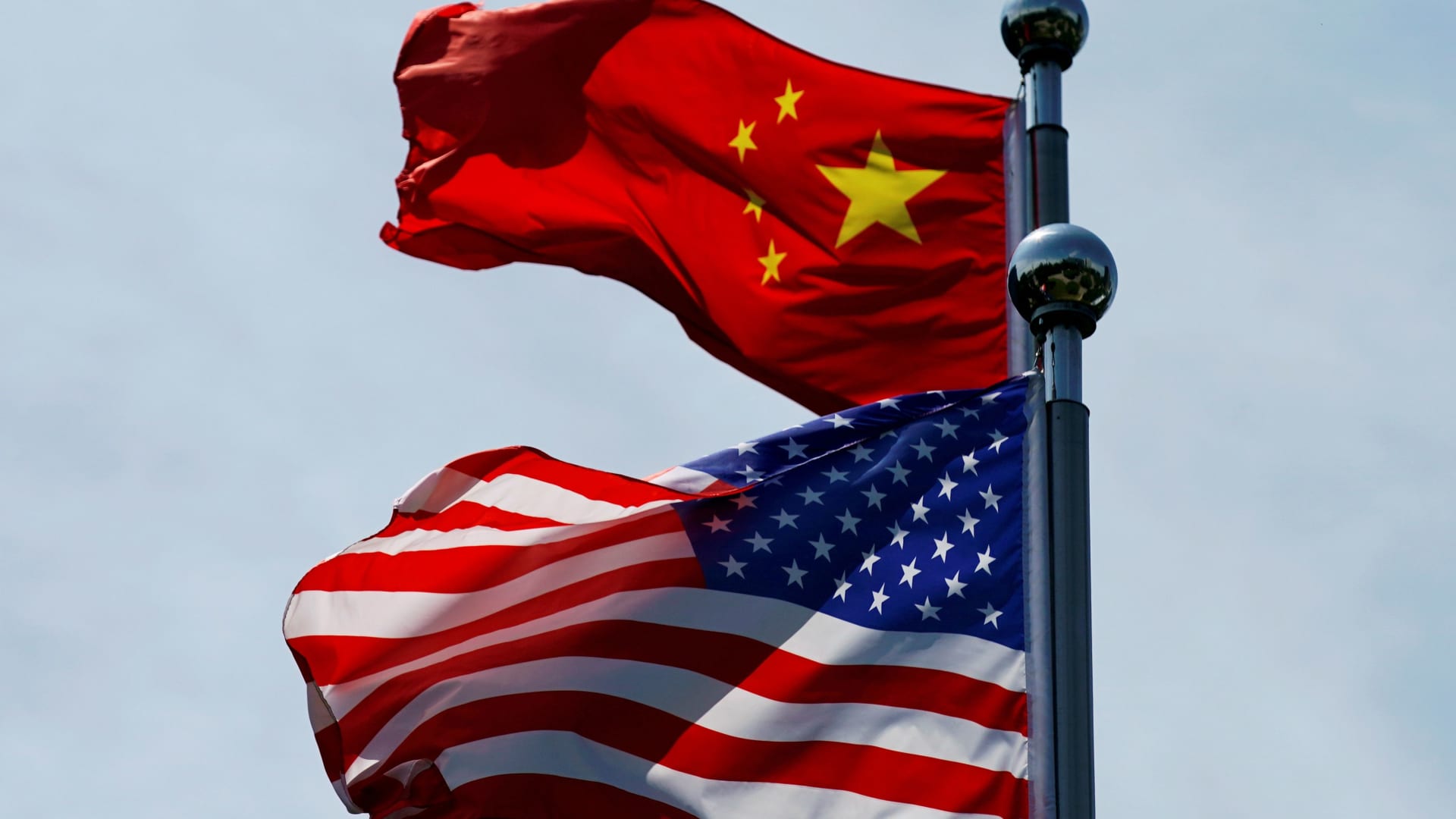
Chinese and U.S. flags flutter near The Bund, before U.S. trade delegation meet their Chinese counterparts for talks in Shanghai, China July 30, 2019.
Aly Song | Reuters
SUZHOU, China — The U.S. is working hard to ensure American technology is used in Asia, a senior State Department official told CNBC, as China races to build alternatives that are often cheaper.
“We’re very active in promoting U.S. AI options and solutions,” Casey K. Mace, senior official for APEC and economic policy, told CNBC on Friday on the sidelines of the APEC trade ministers’ meeting in Suzhou, and a week after U.S. President Donald Trump brought a host of tech CEOs on his visit to the country.
As the two countries race to develop the technology, the U.S. has restricted Chinese access to advanced U.S. chips. Beijing has already banned Google and Facebook in mainland China.
Mace said U.S. tech companies would be giving workshops at an APEC “digital week” in Chengdu in July. While China is the host of the event, “it’s an opportunity to engage with all 21 [APEC] economies,” he added.
Mace declined to name specific U.S. companies taking part, and pushed back when asked if the U.S. was advocating “best in class” American tech over Chinese alternatives.
He said he had met with U.S. tech companies with a presence in China and that he expected they would be able to expand their access to its market.
China is hosting this year’s APEC trade ministers’ meetings, which are set to wrap up in November in the tech hub of Shenzhen.
Working-level conversations alongside Asia Pacific Economic Cooperation meetings in China this month focused on promoting U.S. AI in food traceability, genome sequencing and biotech, Mace said.
He said the tone has been “positive,” which he attributed partly to the “very successful meeting between President Trump and President Xi” in Beijing last week.
Following high-level engagement, the two countries have agreed to begin discussions about safe development of AIChina’s foreign ministry confirmed on Tuesday. It’s unclear when or how those talks will begin.
“There is pressure to distribute American compute globally,” Ryan Fedasiuk, fellow at the American Enterprise Institute, told CNBC last week.
“The Trump administration is right in trying to advocate and implement with this,” he said. “But it will compete with Chinese hyperscalers and Chinese AI labs that are attempting to do exactly the same.”
Fedasiuk added that he is watching for coordination between the U.S. and Chinese sides to screen vendors of DNA synthesis services so as to prevent the manufacture of another pandemic.