
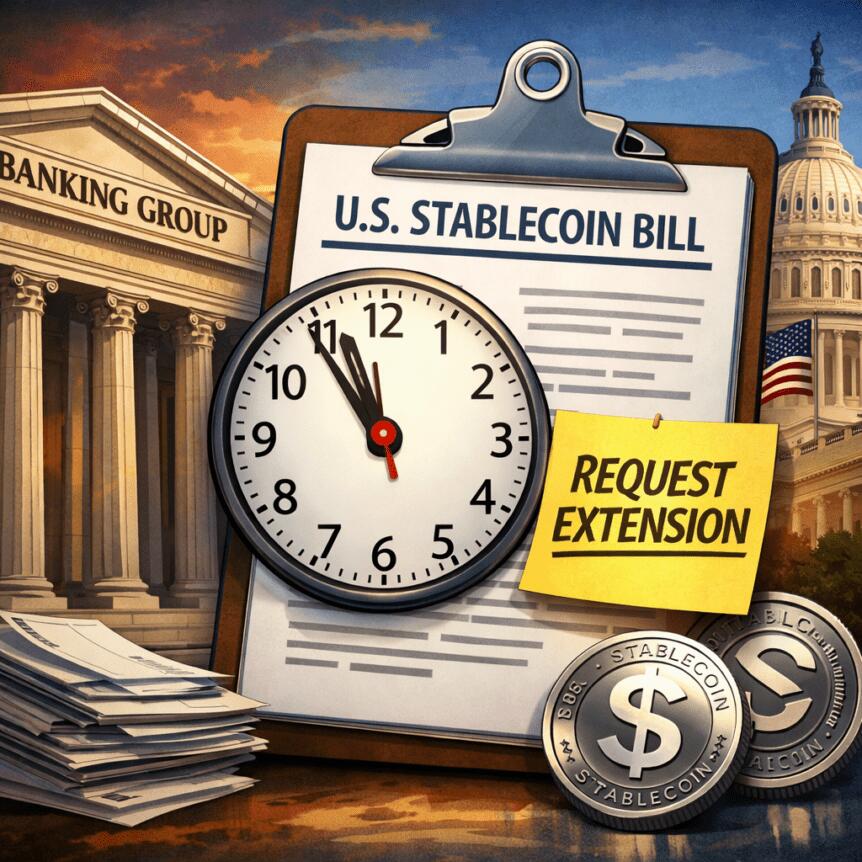
The American Bankers Association (ABA) has urged US government agencies overseeing a forthcoming stablecoin payments framework to extend the public-comment window, signaling that the regulatory process could slip by as much as two months. The request highlights how the GENIUS Act’s implementation hinges on cross-agency rulemaking and the content of the OCC’s forthcoming rule.
In a letter to the Treasury Department, the Federal Deposit Insurance Corporation (FDIC), FinCEN and the Office of Foreign Assets Control (OFAC), the ABA asked for a 60-day extension to submit feedback on proposed rules associated with the GENIUS Act, which was signed into law in July 2025. The ABA argued that the agencies’ final rules will be substantially influenced by the OCC’s rulemaking, and that meaningful public comment is not feasible until the OCC’s content is known.
“The FDIC has stated explicitly in its notice that it ‘has endeavored, in many areas, to align this proposed rule with the OCC’s proposed rule, to the extent relevant,’ and specifically invites comment ‘on the extent to which the primary Federal payment stablecoin regulators should further align in their final rules to promote consistency of regulations applicable to all PPSIs subject to the GENIUS Act,’” the ABA wrote. “Meaningful comment on that question is impossible without knowing the final content of the OCC’s rule.”
Following its enactment, GENIUS-based implementation has shifted to regulators such as the FDIC and the Treasury, which must finalize their own regulations. Under the statute, final rules can trigger enactment 120 days after their issuance or 18 months after enactment, whichever comes first.
Beyond the GENIUS Act, the ABA is engaged in broader policy debates over crypto market structure and the treatment of stablecoin yields. The association recently challenged a White House report that argued banning stablecoin yields would have a negligible impact on banks. The policy dialogue gains urgency as lawmakers in the US Senate consider advancing a separate crypto-market framework known as the CLARITY Act, which previously passed the House of Representatives but has yet to secure traction in the upper chamber. Reports indicate ongoing scheduling considerations by Senate leadership and committee chairs, underscoring continued regulatory uncertainty in this space.
Key takeaways
- The ABA seeks a 60-day extension for public comments on GENIUS Act rulemaking, citing alignment needs with OCC’s forthcoming rule.
- ABA officials argue that meaningful comments depend on the OCC rule’s final content, creating a sequential regulatory dependencies problem across federal agencies.
- GENIUS Act implementation remains tied to a clear regulatory timetable: final rules can trigger enactment within 120 days or within 18 months of enactment, whichever occurs first.
- Debates over stablecoin yields and market structure persist, with the CLARITY Act’s fate in the Senate contributing to ongoing policy uncertainty for banks, exchanges and stablecoin issuers.
- The discussion illustrates heightened cross-agency coordination challenges and signals potential impacts on licensing, supervision and compliance workflows for crypto firms and traditional banks alike.
GENIUS Act rulemaking and interagency alignment
The ABA’s advocacy centers on the interaction between the OCC’s forthcoming stablecoin rule and parallel proposals from the FDIC, FinCEN and OFAC. The core concern is regulatory coherence: should the agencies align their final rules to ensure consistent treatment of all primary Federal payment stablecoin issuers (PPSIs) under the GENIUS Act? The ABA’s position reflects a broader industry demand for predictable, harmonized standards that reduce compliance fragmentation across banking and payments regimes.
From a regulatory design perspective, the unfolding process underscores how a landmark act can produce a multi-year, multi-agency rulemaking odyssey. Agencies argue that alignment is essential to avoid a patchwork of rules that could complicate risk management, AML/KYC controls and supervision of cross-border payment flows. The ABA’s request emphasizes practical consequences for institutions drafting governance, risk and compliance programs that must adapt to evolving standards across several federal agencies, particularly in the payments and stablecoin spheres.
Implementation timing and policy uncertainty in the US framework
The GENIUS Act’s path to effectuation depends on final rule content from multiple agencies. The statute allows enactment 120 days after final regulations are issued or 18 months after enactment, whichever comes first. This construct creates a two-front timeline: (1) regulatory finalize-and-publish cycles at the OCC and sibling agencies, and (2) the practical deployment of supervision and oversight for PPSIs and stablecoin-related payment systems. The ABA’s letter is a bid to ensure that the public comment process is not artificially constrained by uncertainties about the OCC’s final rule.
In parallel, the policy dialogue around crypto market structure remains active. The CLARITY Act—previously advanced in the House and now awaiting movement in the Senate—continues to shape expectations about how yield-bearing stablecoins may be treated within the broader licensing, capital adequacy and consumer-protection regimes. Observers note that even as individual provisions may differ between the House and Senate, the underlying concern is the same: how to balance market innovation with robust oversight and systemic risk mitigation. Senate discussions, including inputs from lawmakers such as North Carolina Senator Thom Tillis, indicate a careful, incremental approach rather than an immediate, sweeping reform.
Regulatory coordination, enforcement and the broader policy context
The GENIUS Act episode illustrates a broader regulatory coordination challenge facing the US financial system as it engages with stablecoins and digital-asset payments. Agencies are weighing alignment on core issues such as KYC/AML controls, cross-border settlement risk, consumer protection and the resilience of payment rails. The interplay between the OCC’s forthcoming rule and the final versions from the FDIC, FinCEN and OFAC has practical implications for bank partners, fintechs and crypto firms that rely on or interact with PPSIs.
From a compliance and enforcement perspective, the ongoing harmonization effort could affect licensing trajectories, supervisory approvals and ongoing audits. Institutions may need to adapt policies to reflect a shared regulatory baseline, reducing the risk of conflicting interpretations across federal authorities. The evolving framework also has cross-border relevance, as global policymakers seek coherence between the United States’ approach and regional regimes—such as the European Union’s MiCA framework—and other jurisdictions evaluating similar stablecoin and payment-token regulations. While the current focus is domestic, observers are watching how interagency coordination and alignment will influence international cooperation, information sharing and enforcement coordination in the longer term.
According to Cointelegraph reporting, the public comment process remains a critical mechanism for industry input, and the ABA’s push for more time signals the stakes attached to regulatory predictability for banks, financial institutions and crypto market participants alike. The outcome of OCC deliberations and the extent of cross-agency alignment will likely shape the early implementation milestones of the GENIUS Act in the months ahead.
Closing perspective: as regulators refine the architecture of stablecoin payments, institutions should prepare for a period of intensified scrutiny and evolving standards. The next developments to watch include the OCC’s final rule content, how other agencies respond to it, and the progress—or stalling—of the CLARITY Act in the Senate, all of which will guide licensing, risk management and compliance strategy for market participants.