

Today in crypto, US lawmakers advanced a crypto tax proposal that notably excludes a Bitcoin-specific exemption, signaling a stricter regulatory stance. Meanwhile, New York Stock Exchange (NYSE) parent, Intercontinental Exchange (ICE), doubled down on its bet on Polymarket with a fresh $600 million investment, and Strategy executives Michael Saylor and Phong Le revealed that retail investors are the biggest buyers of their Stretch perpetual preferred shares.
US lawmakers advance crypto tax plan without Bitcoin exemption
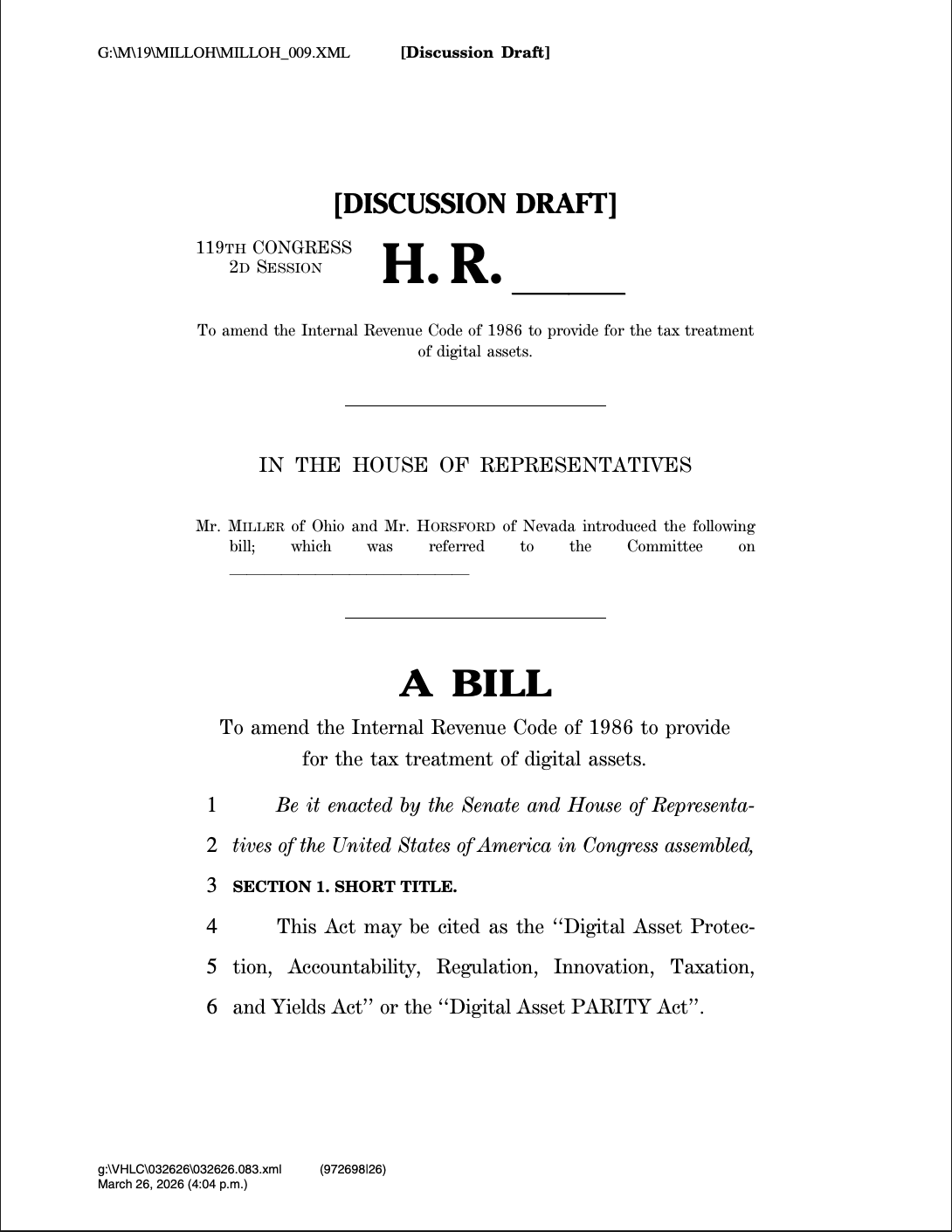
US lawmakers have released a discussion draft of the Digital Asset PARITY Actoutlining new crypto tax rules that notably exclude a Bitcoin de minimis exemption. Instead, the proposal introduces limited tax relief for certain dollar-pegged stablecoin transactions under $200 and clarifies that income from staking, lending and validator activity would be taxed annually based on fair market value.
The draft, which has not yet been introduced in Congress, is intended to kick off debate around crypto taxation as policymakers push to integrate digital assets into existing financial rules.
The proposal has already drawn criticism from parts of the crypto community, particularly Bitcoin advocates, who argue the bill prioritizes stablecoins over BTC. The move comes amid broader US efforts to define crypto market structure, taxation and regulatory oversight.
ICE completes new $600 million investment in Polymarket
ICE said Friday it completed a new $600 million direct cash investment in Polymarket, deepening its bet on prediction markets as a new area of growth for exchange operators.
The company also said it expects to purchase up to $40 million of Polymarket securities from existing holders, adding to its previously announced investment commitment made in October 2025.
In that earlier deal, ICE said it would invest up to $2 billion in Polymarketmarking one of the largest institutional moves into the prediction market sector. The latest transaction advances that arrangement, though terms for the new investment, including valuation, were not disclosed.
The deal signals ICE’s intention to expand its exposure to prediction markets, even as the sector faces evolving US regulatory scrutiny. At least 11 states are pursuing legal action against prediction market platforms like Polymarket and Kalshi.
80% of Strategy’s “Stretch” buyers are retail investors
Retail investors are reportedly the largest cohort in Strategy’s high-yield, low-volatility “Stretch” shares, which have been used to buy more than $1 billion worth of Bitcoin this year.
Around 80% of the owners of Strategy’s “Stretch” perpetual preferred shares (STRC) are owned by retail, said Strategy CEO Phong Le on Wednesday.
“Retail investors prefer low-volatility, high-yield digital credit,” he added.
“11% is a big number.”
“Am I offending you if I call it a money market fund?” – @SullyCNBCDigital Credit is redefining yield.
Today we discussed Stretch $STRC on @PowerLunch. pic.twitter.com/oirw3PGZBi— Michael Saylor (@saylor) March 26, 2026
The figure suggests that retail investors are still interested in exposure to Bitcoin, even though it is down about 45% from its all-time high.
Strategy’s executive chairman, Michael Saylor, has been stepping up sales and marketing of Stretch following the drop in Bitcoin and company stock, pitching the shares as a way to get exposure to BTC without the volatility.
In March, Strategy used around $1.2 billion from at-the-market sales of STRC to buy Bitcoin, though it switched back to using the sale of common stock in its most recent buy.